


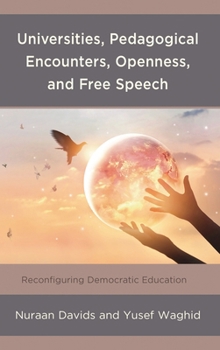
Universities, Pedagogical Encounters, Openness, and Free Speech: Reconfiguring Democratic Education

The authors have spent their lives in South Africa, are writing this book from and within a very particular context of compounded oppression, marginalisation and otherness. In many ways, apartheid has both damaged and provided us with the emotions and language through which to speak from and about harmful speech. That apartheid managed to succeed in its depravity for as long as it did, begins to provide some hint to the often-underestimated power and debilitation of speech and language. This book, therefore, is not only an interpretation and analysis of what a philosophy of education might have to offer in relation to the debate on free speech. Rather, it is also an attempt to make meaning of lived experiences - its encounters, it conflicts and its harms - so that this debate is extended beyond conceptual deliberations and into a realm of human and humane dialogue for the sake of seeing and knowing one another.
The authors are intent upon understanding the arguments--both for and against freedom of speech--for the purpose of what makes educational sense. In short, the book questions whether constraining any form of speech would create conditions for control and manipulation that affect pedagogical encounters adversely. If encounters were to remain justifiable, ways should be found to undermine a restriction on free speech rather than encouraging the advocacy of constrained free speech within pedagogical encounters. The authors raise questions about whether an argument for free speech can ensure more durable and justifiable pedagogical encounters in which the rights of teachers and students to exercise their rights to uncensored free speech should and would never be violated.
Customer Reviews
ThriftBooks® and the ThriftBooks® logo are registered trademarks of Thrift Books Global, LLC
