


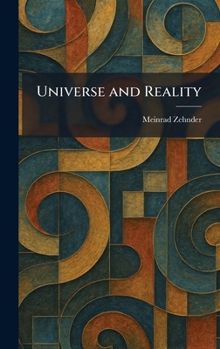
Universe and Reality

"Universe and Reality" is a profound exploration of the nature of existence and the structure of the cosmos. In this work, Meinrad Zehnder delves into the complex intersection of scientific inquiry and philosophical contemplation, examining how human consciousness perceives the physical world. The text seeks to reconcile the vastness of the universe with the underlying principles of reality, offering a systematic investigation into the fundamental laws that govern our world.
Through a series of analytical reflections, the author investigates themes of space, time, and the cosmic order. Zehnder's approach is both rigorous and speculative, inviting readers to consider the deeper metaphysical implications of scientific discovery. The work reflects a significant period in the early 20th century when the boundaries between objective science and subjective understanding were being actively redefined.
Ideal for students of metaphysics and the history of ideas, "Universe and Reality" provides a compelling look at the human quest to define the essence of being. This treatise remains a notable contribution to the dialogue between physics and philosophy, offering timeless insights into the attempt to grasp the infinite nature of our surroundings.
This work has been selected by scholars as being culturally important, and is part of the knowledge base of civilization as we know it. This work was reproduced from the original artifact, and remains as true to the original work as possible. Therefore, you may see the original copyright references, library stamps (as most of these works have been housed in our most important libraries around the world), and other notations in the work.
This work is in the public domain in the United States of America, and possibly other nations. Within the United States, you may freely copy and distribute this work, as no entity (individual or corporate) has a copyright on the body of the work.
As a reproduction of a historical artifact, this work may contain missing or blurred pages, poor pictures, errant marks, etc. Scholars believe, and we concur, that this work is important enough to be preserved, reproduced, and made generally available to the public. We appreciate your support of the preservation process, and thank you for being an important part of keeping this knowledge alive and relevant.
Customer Reviews
ThriftBooks ® and the ThriftBooks ® logo are registered trademarks of Thrift Books Global, LLC
