


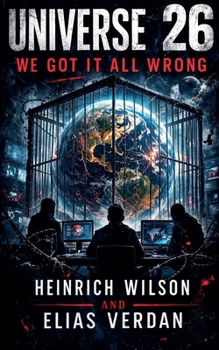
Universe 26: We Got It All Wrong

Universe 25 meets quantum physics.
In 1968, behavioral researcher John B. Calhoun constructed a perfect world for a colony of mice. Every need was met. Food was unlimited. Water was unlimited. There were no predators, no disease, no threats of any kind. He called it Universe 25, and it was designed to be paradise.
The mice thrived at first. They bred, formed social groups, and built a functioning colony. Then, despite having everything they could ever need, the society began to collapse from within. Males became aggressive without reason. Females abandoned their young. A group Calhoun called the beautiful ones withdrew from life entirely, spending their days grooming themselves in isolation while the colony crumbled around them. Reproduction slowed, then stopped. Every mouse died. Not from hunger. Not from disease. From the complete psychological collapse of a society that had everything except a reason to exist.
Calhoun ran this experiment twenty five times. The result was always the same.
Universe 26 asks the question that most people are not prepared to sit with. What if Calhoun did not invent this experiment? What if he replicated one that was already running? What if the cage is not a metal box in a laboratory but a planet? What if the unlimited resources are not food dispensers but the Earth itself? And what if we are the mice?
Drawing on behavioral science, quantum physics, the simulation hypothesis, mass extinction events, religious tradition, and the demographic data of the modern world, Heinrich Wilson and Elias Verdan trace the parallels between Calhoun's doomed colony and the trajectory of human civilization. Falling birth rates. Rising isolation. Epidemic levels of depression and suicide in the most prosperous societies on Earth. The collapse of family, community, and social trust. A generation of beautiful ones retreating into screens while the world around them quietly falls apart.
The resets have happened before. The instructions have been given before. The warnings have been ignored before. And now, for the first time, the silence suggests that whoever was watching has stopped intervening.
This is not speculation. This is pattern recognition. And the pattern has only ever ended one way.
We got it all wrong.
Customer Reviews
ThriftBooks® and the ThriftBooks® logo are registered trademarks of Thrift Books Global, LLC
