


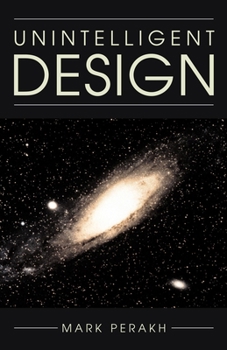
Unintelligent Design

Select Format
Select Condition 
Book Overview
Physicist Mark Perakh critically reviews recent trends toward harmonizing religion and science. From intelligent design theories to arguments allegedly proving the compatibility of biblical stories with scientific data and "Bible codes" containing secret messages, Perakh shows that, however sophisticated in appearance, all such approaches are little more than tailoring evidence to fit the desired theory.Beginning with the design theorists, Perakh provides a detailed critique of the publications of William Dembski, Michael Behe, and Phillip Johnson. In each case he clearly demonstrates lack of substantiation, internal contradictions, and multiple fallacies that mar their works.In Part Two he critiques the "mental acrobatics" of various Christian and Jewish writers whose works attempt to prove such unlikely propositions as: the inerrancy of the Bible, the harmony of the Torah and science, the duration of the six days of creation, and deriving a theory of nonrandom evolution from the Talmud.Part Three describes how genuine science is conducted, what the laws of science actually mean to practicing scientists, and what distinguishes real science from pseudoscience.In conclusion, Perakh discusses the rise and fall of the so-called Bible code as an example of how well-marketed pseudoscience can successfully cloak itself in the mantle of science.For everyone interested in separating scientific facts from the hype of trendy theories about science, this book is must reading.
Format:Hardcover
Language:English
ISBN:1591020840
ISBN13:9781591020844
Release Date:December 2003
Publisher:Prometheus Books
Length:459 Pages
Weight:1.65 lbs.
Dimensions:1.6" x 6.3" x 9.1"
Customer Reviews
4 ratings
High calibre thinking, but occasionally dry and difficult.
Published by Thriftbooks.com User , 20 years ago
Given the title, I had expected to see humorous examples of bad "design" in nature, as a demonstration that nature was most likely not designed. For example, ground dwelling parrots in New Zealand who are highly vulnerable to predators and have a very difficult time locating mates because their calls echo too much, or the problems with the human legs, spine, and hips that come from incomplete evolution from pre-humans to walking people. I was a little disappointed that similar examples of "unintelligent design" weren't covered. Nevertheless, it's a good book. Professor Perakh's book is written as a series of book reviews and critiques, with a couple of chapters toward the end on what science is and how probabilities are determined. His reviews start with the chief proponents of intelligent design theories, and move on to others who have tried to reconcile science and religious texts. I found that this book was occasionally dry and difficult to read. I have to confess that I put some of my difficulty in reading this book down to the fact that its author is a physicist, and I am not used to the style of that discipline. Although this book is intended for a general audience, the author's professional area of expertise does strongly influence the style, content, and focus. Having said that the book is sometimes difficult, I found that I could understand the challenging sections with a little effort and re-reading. That aside, what was very striking is that, at times, beautifully clear and incisive points made by the author criticizing proponents of "intelligent design" theories jump off the page. There is some truly razor-sharp logical and evidentiary analysis. In my opinion, it is particularly the first 138 pages of the book, dealing with the work of Dembski and Behe, that are the hardest to follow. Part of dryness has to do with the fact that in critiquing Dembski the author has to quote heavily from Dembski's work, and Dembski's work seems to be characterized by deliberate obscuritanism. One of the spotlight reviews describes this book as "Well worth the effort". I agree, it is.
Well worth the effort
Published by Thriftbooks.com User , 22 years ago
I've been reading about the creationism/evolution debate for twenty years now, and this book is an extremely important addition to that discussion. Perakh has two basic points as he works his way through the major advocates of ID (Intelligent Design). One is that they misuse statistics is ways that are intuitively reasonable but ultimately incorrect. This is why he includes a discussion of the Bible Code, another case of statistics gone awry.His second point, and one that I hadn't seen spelled out so well before, is that the idea of irreducible complexity is a jumbled compilation of observations which Paley and others have offered much more clearly long ago. Perakh breaks down each component of irreducible complexity and shows how it does not justify the strong claims made for it by ID theorists.My frustration in all of this is that the people who most need to read this book aren't going to take the time and effort necessary to engage in his arguments.
Unconventional but very successful
Published by Thriftbooks.com User , 22 years ago
A new player seems to have appeared on the field, and he seems to be indeed a good player. There have been many books published which approach the Intelligent Design-related controversy from various vantage points, and some of them have been quite good.To find an additional niche for another book was not an easy task. Perakh, in my view, has done it quite successfully - his book is unlike any other published so far about Intelligent Design or about biblical neo-apologetics. The format of this book is rather unconventional - it is built around a set of publications (books and articles) by, first, the most prominent defenders of the Intelligent Design and, second, by some Christian and Jewish writers, all of whom Perakh unequivocally debunks. I was impressed by the strict logic of Perakh's narrative. For example, after having read chapter 1, which contains a very meticulous analysis of publications by William Dembski (perhaps the most prominent champion of Intelligent Design), I could not help but to say to myself, "Gee, the king is naked." Using unrelenting logic, Perakh has demonstrated the lack of substance in Dembski's theory, whose quasi-mathematical appearance serves as pure embellishment covering the lack of meaningful contents. I will be looking for other publications by Perakh, starting from his posts on the Talk Reason web site. Welcome to the fray, Perakh, you get five stars from me.
A book that is cleaning up the mess
Published by Thriftbooks.com User , 22 years ago
To anybody who wishes to keep abreast with the fight between ID advocates and their detractors this book is a must. I have used the word fight deliberately - the dispute in question is not much like a normal dispute in science but is often redolent of a skirmish between two street gangs. Though this book has its (small) share of emotional outbursts, on the whole is remarkable by its restrained tone as its author, whose sympathies clearly belong to the anti-ID camp, obviously intends to be as objective as possible. When his critique of errors by some of the writers who are objects of his debunking effort may sometimes sound quite harsh, it is usually simply a result of the gravity of their errors. It may be an unrewarding job to clean up the mess created by under-qualified contributors to the discussion, but this is a job which is necessary and I think we have to be grateful to Perakh for endeavoring to perform such cleansing. Given the emotional atmosphere in the fight between Intelligent Design and anti-ID groups, the tone of Perakh's book may in fact be judged to be quite moderate. The important point is, though, that Perakh's discourse, which reveals his extensive knowledge of the subject, is convincing throughout and ensures his book a rightful place among five-star choices.
Copyright © 2026 Thriftbooks.com
Terms of Use | Privacy Policy | Do Not Sell/Share My Personal Information | Cookie Policy | Cookie Preferences | Accessibility Statement
ThriftBooks ® and the ThriftBooks ® logo are registered trademarks of Thrift Books Global, LLC
ThriftBooks ® and the ThriftBooks ® logo are registered trademarks of Thrift Books Global, LLC
