


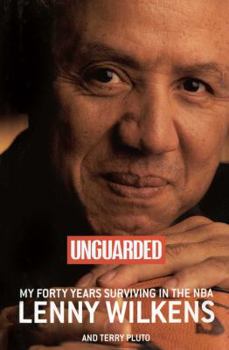
Unguarded: My Forty Years Surviving in the NBA


Select Format
Select Condition 
Book Overview
Unguarded reveals the Lenny Wilkens we have never seen before, the tough, strong, thoughtful, and analytical man who has spent a life in basketball making his teammates and players better than they knew they could be. Thought-provoking, candid, always honest, Wilkens shares all the secrets he's learned in his four decades surviving in the NBA storm. For forty years, he has been the Quiet Man of the NBA. As a rookie, he was overshadowed by two pretty fair guards who entered the league at the same time: Jerry West and Oscar Robertson. As a veteran, he was--both figuratively and literally--a coach on the floor, but he had the misfortune to play for several struggling teams. As a general manager, he won a championship and made back-to-back Finals appearances--but he did it without superstars, a year before Magic Johnson and Larry Bird revitalized the league. And as a coach, he has won more games than anyone in NBA history--but spent his best years locked in the same division as Michael Jordan's Chicago Bulls. Basketball connoisseurs have long appreciated the style and intelligence with which Lenny Wilkens played and the unflappability and class he's brought to coaching. The respect he has earned resulted in his joining the legendary John Wooden as the only men to be inducted into the Basketball Hall of Fame twice--first as a player, and then as a coach. Now, in Unguarded, Lenny Wilkens steps out from behind his placid demeanor to speak plainly and unequivocally on the enormous social and athletic changes he's seen in his career. Wilkens sounds off about the challenges he had to overcome in the course of his journey: the racism that left him off the 1960 Olympic basketball team and kept him from being chosen as head coach of the first Dream Team; the fatal miscalculation that kept his Cleveland Cavaliers from getting past Michael Jordan to the NBA Finals; the painful, frustrating task of coaching a troubled and troublesome J.R. Rider, a player who contributed to his departure from Atlanta. And he credits those who went out of their way to help him: the priests and nuns who taught him the value of discipline and reinforced his faith; the coaches who pushed him to develop his talents to the fullest; the selfless players such as John Johnson, Hot Rod Williams, Larry Nance, Steve Smith, and many others who sacrificed individual glory for the good of their teams; his mother, Henrietta, and his wife, Marilyn, who stood beside him in many trying times.
Format:Paperback
Language:English
ISBN:1476748667
ISBN13:9781476748665
Release Date:May 2013
Publisher:Simon & Schuster
Length:312 Pages
Weight:0.75 lbs.
Dimensions:0.9" x 5.4" x 8.3"
Customer Reviews
5 ratings
A Great Book
Published by Thriftbooks.com User , 17 years ago
In 1960, when Lenny Wilkens graduated from Providence, he honestly didn't expect to be playing in the NBA - his idea was to go into teaching or another job - he barely even played a season of high school ball. A player like Wilt Chamberlain was coveted by the NBA probably when he was in junior high - a player like Bill Russell was coveted coming out of USF. Lenny Wilkens lasted alot longer than any of them in the NBA becoz he had to work for everything he got - that's the kind of player, the kind of athlete that is missing nowadays and the kind of athlete we will never see again - that's what makes this low key book a great read. Yes, he does play the race angle a little but not being in his shoes, I had no idea what he went through either. You won't go wrong with his book.
A GOOD EXAMPLE OF DIGNITY AND CLASS
Published by Thriftbooks.com User , 21 years ago
LENNY WILKENS DOES A GOOD JOB RELAYING HIS LIFE AND CAREER. HE HAS ALWAYS BEEN AN EXAMOLE OF CLASS AND GOOD WORK ETHICS. I REMEMBER HIM WITH CAVALIERS IN THEIR EARLY YEARS TRYING TO MAKE THE TRANSITION FROM THE BOTTOM TO CONTENDER. HE HELPED ADD SOME LEADERSHIP AND EXPERIENCE FOR ALOT OF YOUNG PLAYERS. LATER ON HE WOULD BE THE MOST SUCESSFUL COACH IN CAVALIER HISTORY. I LIKED HIS BOOK AND AGREE HE WAS OVER LOOKED AS A PLAYER AND COACH. A VERY CLASSY INDIVIDUAL AND INTELLIGENT. RECOMMENDED FOR YOUNG AND OLD SCHOOL PLAYERS.
A classy memoir from a classy individual
Published by Thriftbooks.com User , 24 years ago
I was drawn to "Unguarded" primarily because I grew up with the Sonics coached by Lenny Wilkens. I remember the championship season he guided the team to, and have always rued the day he left the Sonics for other coaching endeavors. This book isn't verbose, and doesn't go into tremendous detail about every aspect of his career, but this style works for Mr. Wilkens. What the reader gets is a nice, classy snapshot of a career that has - as player and coach - encompassed the rise and current decline of the NBA. I was particularly fascinated with his descriptions of the NBA he played in during the 1960's. The murky arenas, low pay, poor treatment of players in general, the caste system between rookies and veterans, and subtle bigotry were all things Mr. Wilkens highlighted. Most NBA fans would no doubt imagine the league as always being the "showtime", glamorous atmosphere of the Magic-Bird-Jordan era. Mr. Wilkens' description would probably be as surprising to the hard-core fan as it would be to the non-fan. I also found his opinions on the current state of the game to be fascinating. He laments the "SportsCenter" style of play where everyone's playing for highlight reel material, the "me-first" attitude among players, and the general loss of the art of the game he played. These are all things that have prompted me to quit watching NBA basketball in recent years, so I couldn't help but say a quiet "amen" as I read the book. One of the troublesome areas I found with the book were when he addressed the topic of racism. In the very first chapter he tackles it head-on, saying that he saw it and experienced it, but then alluding that he doesn't dwell on it or hold grudges. However, when it arises in later chapters - notably in his being left off the Olympic team as a player or when up for coaching the original "Dream Team" - Mr. Wilkens comes off as definitely holding grudges and letting racism play a big factor in his life. It is a paradox I couldn't grapple with personally. I certainly don't deny he was treated horribly in situations based on his race, but I found that it was almost as if he was trying too hard to walk the tightrope between being bitter and handling the issue with class. It was an area of the book that just didn't work, because you couldn't tell whether he had indeed let it go or was still holding grudges on many an situation. All in all, though, this was a nice memoir. There is nothing scandalous revealed, and he doesn't attack anyone - even in his descriptions of the aforementioned racial treatment or in his criticism of the modern game. Perhaps this also accounts for the puzzling, clumsy way he addresses racism, because while he does criticize a few, he writes very well of those who fired him or cut him over the years. There is no doubt Mr. Wilkens has led an extraordinary career, and has done so with dignity, modesty, and class. We get our best glimpse of this tremendous man with this book, and I recommend it to fans and non-fans o
All Young Basketball Fans Should Read This Book
Published by Thriftbooks.com User , 24 years ago
I am not a fan of the NBA. I am not even a basketball fan. I bought and read this book because Lenny Wilkens was a member of the St. Louis Hawks of the 1960's when I closely followed the Hawks of Bob Pettit, Cliff Hagan, "The Big Z" Zelmo Beaty, John "Rabbit" Barnhill, Chico Vaughn, and others. I was interested in reading what Wilkens would have to say about the Hawks. According to Wilkens, coaching in the NBA in the '60's consisted of scrimmaging and shooting free throws. Rather than teaching, coaches screamed at players. Wilkens says that one of his Hawks' coaches, Richie Guerin, played favorites namely Bill Bridges and Gene Tormohlen. Wilkens credits his faith in God for directing his life and for providing him with the many blessings that have come his way. Having graduated from Providence with a degree in economics, he had no idea he would be playing in the NBA. He takes the reader through the discrimination he encountered in St. Louis during the '60's and how this was all new to him having been raised in Brooklyn, New York. Wilkens provides us insight of his experiences of playing with St. Louis followed by the trade to Seattle and his two coaching stints there along with coaching at Cleveland, Portland, Atlanta, and now Toronto. Along the way he managed to pass Celtic legend Red Auerbach's career victory total. Both Wilkens and former UCLA Bruins' coach, John Wooden are the only two members elected to the Basketball Hall of Fame as both players and coaches. I rate this book five stars, not because it is a keeper for me. I plan on sending this up to our local high school library so people who are interested in basketball can benefit from this book. In addition, how refreshing to read a book without any profanity. Lenny Wilkens, you have been a credit to the game of basketball and you will touch a number of lives of those who will read your book.
Very good.
Published by Thriftbooks.com User , 24 years ago
This memoir is low-key, yet quite emotional. No NBA fan will find it a waste of time. Like many of his generation, Wilkens longs for basketball to be like its past, like the game he played. But that age is gone forever; it only survives in an excellent memoir like this one, or in the work of co-author Terry Pluto.Roland Lazenby Author of Mindgames, Phil Jackson's Long Strange Journey
Copyright © 2026 Thriftbooks.com Terms of Use
| Privacy Policy | Do Not
Sell/Share My Personal Information | Cookie Policy | Cookie Preferences | Accessibility Statement
ThriftBooks® and the ThriftBooks® logo are registered trademarks of Thrift Books Global, LLC
ThriftBooks® and the ThriftBooks® logo are registered trademarks of Thrift Books Global, LLC
