


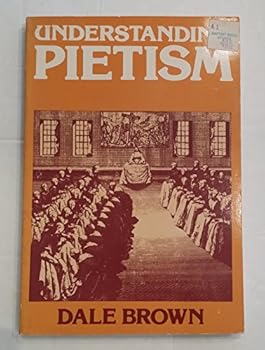
Understanding Pietism

A helpful introduction to the history and theology of Pietism. Widely used as a church history text, this book surveys the Pietist movement in Europe and America. This description may be from another edition of this product.
Format:Paperback
Language:English
ISBN:0802817106
ISBN13:9780802817105
Release Date:January 1
Publisher:Eerdmans Publishing Company, William B.
Length:182 Pages
Weight:0.45 lbs.
Customer Reviews
1 rating
An Overview & Defense of Pietism as Represented by Spener & Francke
Published by Thriftbooks.com User , 16 years ago
The book's title needs clarification which is provided by the title of Brown's 1962 doctoral dissertation on which it is based: "The Problem of Subjectivism in Pietism: A Redefinition with Special Reference to the Theology of Philipp Jakob Spener and August Hermann Francke". As the dissertation title indicates, the book is focused on the theology of Pietism's early representatives Spener (1635 - 1705) and Francke (1663 - 1727). Their thought is used to address the generally negative assessments of Pietism as connoting subjectivism, individualism, and otherworldliness with the hopes of creating a more balanced assessment that takes into consideration positive contributions while not ignoring in their theology the seed of later degenerations such as hypocritical legalism, experiential fanaticism, narrow-minded dogmatism, and loveless separatism. Brown distinguishes between Churchly or Classical Pietism and Radical Pietism, the former label used to include the thought of Spener and Francke and the latter label used for "those who had greater despair about the church and greater appropriation from the writings of late medieval mysticism" (page 23). Brown's book addresses beliefs identified with Radical Pietism in the first chapter, but his primary focus is on the motifs of Churchly or Classical Pietism. I recommend other resources such as The Pietist Theologians (2004), edited by Carter Lindberg, for more thorough introductions to some of the primary Radical Pietists such as Gottfried Arnold and Gerhard Tersteegen. Brown looks at both negative and positive assessments of Pietism, providing references in both his chapter notes and bibliography. He is particularly indebted, and gives special credit to, the works of the late F. Ernest Stoeffler who he says deserves the title of Dean of American Pietist historians and whose works provided the basis and motivation for scholars listed in the first chapter and the appended bibliographical section of his book. This includes Peter Erb whose works helped introduce me to Pietism as it relates to mysticism. Brown's own interest in the topic, and sympathetic bias, comes from his background in the Church of the Brethren which, he was told, had Pietist origins. Brown covers the roots of Pietism not only in mysticism but also in Lutheranism, Calvinism, and Anabaptism before exploring its central theological motifs of love theology, reformation of the church, emphasis on the Bible, reformation of life, and theology of experience. Each of these is introduced in the first chapter, but explored in more depth in the subsequent chapters. The inner experience of regeneration is foundational to Pietist theology. According to Brown, "Regeneration was for Spener what justification had been for Luther" (page 66). Although Spener supported the Lutheran emphasis on justification by faith, he particularly emphasized the life-changing nature of that faith through regeneration and sanctification in relationship to
Copyright © 2026 Thriftbooks.com
Terms of Use | Privacy Policy | Do Not Sell/Share My Personal Information | Cookie Policy | Cookie Preferences | Accessibility Statement
ThriftBooks ® and the ThriftBooks ® logo are registered trademarks of Thrift Books Global, LLC
ThriftBooks ® and the ThriftBooks ® logo are registered trademarks of Thrift Books Global, LLC
