


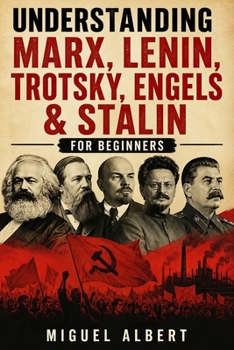
Understanding Marx, Lenin, Trotsky, Engels & Stalin: For Beginners

The ideas of Marx, Engels, Lenin, Trotsky, and Stalin have shaped the modern world more profoundly than those of almost any other thinkers. Yet for most people, these names remain little more than political shorthand, invoked in heated debates but rarely understood in their own terms. This book offers a different path. Written for the absolute beginner, it makes no assumptions about prior knowledge and guides you step by step through the lives, ideas, and historical contexts of the five men whose thought defined twentieth-century communism.
The journey begins in the lecture halls of 1830s Berlin, where a young Karl Marx and his lifelong collaborator Friedrich Engels forged a new way of understanding history, one rooted not in abstract ideas but in the material conditions of human life. You will discover how Engels's firsthand experience of industrial Manchester gave empirical weight to Marx's philosophical insights, and how their partnership produced works like The Communist Manifesto and Capital, texts that dissected capitalism with a precision that remains startling today. From there, the narrative moves to Russia, where Vladimir Lenin transformed Marxism from a theory of historical development into a practical weapon for seizing power. You will learn why his concept of the vanguard party was both a brilliant innovation and a fateful step, and how Leon Trotsky's theory of permanent revolution offered an alternative vision, one that staked the survival of socialism on international revolution.
The final act belongs to Joseph Stalin, the "grey blur" who outmaneuvered his rivals to become absolute master of the Soviet Union. This book explains how Stalinism emerged not simply from one man's evil, but from the tragic intersection of isolation, backwardness, and the bureaucratic logic of a one-party state. You will understand the show trials, the terror, and the personality cult, not as inexplicable madness but as a system with its own brutal internal logic.
This is not a book of apologetics or denunciation. It does not seek to convert you to Marxism or to participate in the ritualistic condemnation of it. Its aim is deeper: to give you the tools to engage with these ideas critically and independently. Each chapter includes guidance for further reading, inviting you to move beyond secondary interpretations and encounter the original voices themselves. By the end, you will not necessarily be a Marxist, a Leninist, or a Stalinist, but you will understand what those terms actually mean, where they came from, and why they continue to echo through our world. In an era of renewed great power conflict, economic crisis, and political upheaval, understanding the intellectual foundations of modern communism is not a luxury. It is a necessity.
Customer Reviews
ThriftBooks ® and the ThriftBooks ® logo are registered trademarks of Thrift Books Global, LLC
