


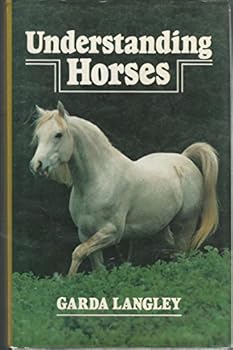
Understanding Horses

Select Format
Select Condition 
Book Overview
The answers to hundreds of questions about the needs and emotions of the horse are contained in this book. It describes in detail their instincts and communication systems, and there are sections on... This description may be from another edition of this product.
Format:Hardcover
Language:English
ISBN:0943955203
ISBN13:9780943955209
Release Date:January 1990
Publisher:Trafalgar Square Pub
Length:216 Pages
Weight:1.34 lbs.
Dimensions:9.0" x 1.0" x 6.0"
Customer Reviews
1 rating
Great guide to better communication with horses!
Published by Thriftbooks.com User , 21 years ago
I received this book as a gift years ago, but never got around to reading it until now. I wasn't expecting a whole lot, since the book has obviously gotten little publicity, but I was pleasantly surprised! Garda Langley, an owner and breeder of Arabian horses in Australia, has put together a terrific guide to understanding and communicating with your horse. The book covers every aspect of owning and caring for a horse, and is divided into chapters on the history of human communication with horses, the needs of horses, their emotions, anxiety, the ways horses communicate with one another, temperament and intelligence, habits, instinct and motivation, breeding, breaking / training, equine illness, and the suitability of different horses for different jobs.I found the text very easy to understand, and Langley's reasoning to be sound. She points out many of the unconscious mistakes horse owners make, explains what negative effects result from these actions, and offers more efficient alternatives. She also details the ways in which horses perceive the world around them, which explains many of the equine behaviors often seen as irrational quirks. Langley also includes a multitude of specific case examples to illustrate her points. In fact, these short stories often make the case themselves, without additional explanation being necessary.The only thing that may take some getting used to is Langley's use of Australian terms and phrases that might not be known to an American reader. For example, a halter is called a "head collar," a blanket is a "rug," a trailer is a "float," a crop is a "cane," and when she says "stable" she means an individual stall, and not the whole barn. Additionally, when rewarding a horse for a job well done you do not praise him or pat him, but rather you "make much of him." For the most part the meanings of these terms are clear from the context, though it did take me a moment to figure out what a float was.A couple of the issues Langley discusses bother me slightly, but they are not really errors, and so I don't feel a need to detract any rating points. First, Langley is very quick to attribute many horses' keen perceptions to clairvoyance or telepathy, when they could just as easily be due to some subtle sensory cue that the horse is attuned to and we are not (for example, elephants can communicate over long distances using sounds too low in frequency for the human ear to detect). She gives one rather dubious example of a man who tested this by setting out several buckets, only one of which contained oats: "He found that he could direct a free horse to choose the correct feed bucket . . . by vizualising in his own mind the oats lying in the bottom" (pg. 80). Now, I'm sure all horse owners know how good horses can be at locating treats, and it seems far more likely that the horse simply smelled the oats in the oat-filled bucket and chose accordingly.The one other thing I'll make note of is that Langley cites horses as being colo
Copyright © 2025 Thriftbooks.com
Terms of Use | Privacy Policy | Do Not Sell/Share My Personal Information | Cookie Policy | Cookie Preferences | Accessibility Statement
ThriftBooks ® and the ThriftBooks ® logo are registered trademarks of Thrift Books Global, LLC
ThriftBooks ® and the ThriftBooks ® logo are registered trademarks of Thrift Books Global, LLC
