


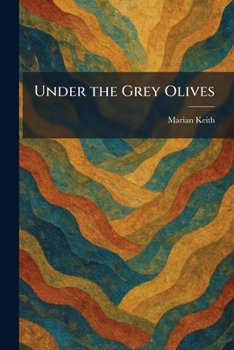
Under the Grey Olives

Select Format
Select Condition 
Book Overview
In "Under the Grey Olives", author Marian Keith presents a vivid and lyrical account of her journey through the Holy Land. Moving beyond a simple travel narrative, the work captures the spiritual and historical resonance of the region during the early twentieth century. Through Keith's keen observational eye, readers are guided from the sun-drenched hills of Galilee to the ancient, winding streets of Jerusalem, encountering a landscape that remains deeply intertwined with its biblical heritage.
The book is composed of evocative sketches that detail the sights, sounds, and daily life of the people living amongst the ancient olive groves. Keith's prose emphasizes the enduring beauty of the landscape and the profound connection between the physical geography and the religious history it hosts. Her reflections provide a bridge between the ancient past and the reality of the region in the 1920s, making the work both a significant historical record and a piece of contemplative travel literature.
"Under the Grey Olives" stands as a testament to the timeless allure of the Middle East, offering a sensitive exploration of faith, tradition, and the natural world. It remains a valuable resource for those interested in the history of travel writing and the cultural landscape of Palestine.
This work has been selected by scholars as being culturally important, and is part of the knowledge base of civilization as we know it. This work was reproduced from the original artifact, and remains as true to the original work as possible. Therefore, you may see the original copyright references, library stamps (as most of these works have been housed in our most important libraries around the world), and other notations in the work.
This work is in the public domain in the United States of America, and possibly other nations. Within the United States, you may freely copy and distribute this work, as no entity (individual or corporate) has a copyright on the body of the work.
As a reproduction of a historical artifact, this work may contain missing or blurred pages, poor pictures, errant marks, etc. Scholars believe, and we concur, that this work is important enough to be preserved, reproduced, and made generally available to the public. We appreciate your support of the preservation process, and thank you for being an important part of keeping this knowledge alive and relevant.
Customer Reviews
ThriftBooks ® and the ThriftBooks ® logo are registered trademarks of Thrift Books Global, LLC
