
Skip to content
Scan a barcode
Scan
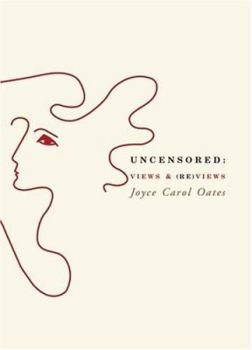
Hardcover Uncensored: Views & (Re)views Book

ISBN: 0060775564

ISBN13: 9780060775568

Uncensored: Views & (Re)views

Select Format

Select Condition ThriftBooks Help Icon

Recommended

Format: Hardcover

Condition: Very Good

$6.69
Save $18.26!
List Price $24.95
Almost Gone, Only 1 Left!
Save to List

Book Overview

Uncensored: Views & (Re)views is Joyce Carol Oates's most candid gathering of prose pieces since (Woman) Writer: Occasions & Opportunities. Her ninth book of nonfiction, it brings together thirty-eight diverse and provocative pieces from the New York Review of Books, the Times Literary Supplement, and the New York Times Book Review.

Oates states in her preface, "In the essay or review, the dynamic of storytelling is hidden but not absent," and indeed, the voice of these "conversations" echoes the voice of her fiction in its dramatic directness, ethical perspective, and willingness to engage the reader in making critical judgments. Under the heading "Not a Nice Person," such controversial figures as Sylvia Plath, Patricia Highsmith, and Muriel Spark are considered without sentimentality or hyperbole; under "Our Contemporaries, Ourselves," such diversely talented figures as William Trevor, E. L. Doctorow, Kazuo Ishiguro, Michael Connelly, Alice Sebold, Mary Karr, Anne Tyler, and Ann Patchett are examined. In sections of "homages" and "revisits," Oates writes with enthusiasm and clarity of such cultural icons as Emily Bront , Ernest Hemingway, Carson McCullers, Robert Lowell, Balthus, and Muhammad Ali ("The Greatest"); after a lapse of decades, she (re)considers the first film version of Bram Stoker's Dracula, and Americana, Don DeLillo's first novel, as well as the morality of selling private letters and the nostalgic significance of making a pilgrimage to Henry David Thoreau's Walden Pond.

Through these balanced and illuminating essays we see Oates at the top of her form, engaged with forebears and contemporaries, providing clues to her own creative process: "For prose is a kind of music: music creates 'mood.' What is argued on the surface may be but ripples rising from a deeper, subtextual urgency."

Customer Reviews

2 ratings

title: uncensored by joyce carol oates

being a woman, oates must get tossed her share of romances. this volume does include reviews of some stories and novels of romance and loss. trained as a philosopher, oates brings to each book reviewed, her honed skills and deep abiding interests. for the most part, joyce carol oates focuses on british and north american authors influenced by henry james and the james joyce of the dubliners, with a few exceptions. the ghostly is at large in these pages, not merely as suggested apparitions, but imbued as loss of missed opportunities, as chances not taken, of lives shaped by loss and experiences of loss, of lives filled with diversion, distraction, boring jobs, and celibacy; and fantasies provided by authors for their lackluster characters-occasionally violence, psychological and actual, activate memory, which otherwise might never be used, rendering the past forgotten. one example, i'll call it an organization of transcendental quanta, a highly sophisicated arrangement of loss, delineated and described by oates in her review of doctorow's city of god-the genuis of the paranoid's web, paranoid here being the intellectuall, the joycean memory one is stuck with, haunted by the nightmare, as doctorow's protagonist moves through the big city where forms of life, forms of religious life, as belief systems, present themselves to immediacy as protean essences. a variation of the ghostly. in other reviews oates ponders the interior life within exterior existence. there's a theory concerning the physical existence of the soul or life force proven by weighing a human body just after death by which the dead body is said to weigh less than when the body was weighed when living by so many grams, and the difference, the loss, is said to be the vanished soul. the views of the subtitle are viewpoints, points of view, a way of seeing, viewing as direct perception. as oates describes in a concluding essay: the nature world of things and situations and the decisions of others as they effect the writings of authors, and authors themselves, when those writings are in the possession of individuals other than the authors, and used without the permission of the authors (my words, not hers). and (re)viewing is another viewing, not of the thing present, but of the thing as past, of the acts and situations enveloping the thing in the past. the thing, the act, the situation, remembered. and the memory that becomes memoir. of the memory become memoir, oates writes in a garden of earthly delights revisited: (w)e write most avidly to memorialize what is past, what is passing, and will soon vanish from the earth.' in them revisited, she refers to the end of the 20th century (had that essay been written later, oates would had included the beginning of the 21st century) as an era of memoir and memoirist fiction. also included are pieces on books about the prizefighters, jack johnson and mohammed ali, and a film memoir. joyce carol oates is a passionate writer and rea

A gripping collection of 38 diverse and provocative pieces

Why would anyone want to do anything as absurd as reviewing a book of book reviews? Because, unlike the readily available volumes of fiction by Joyce Carol Oates, it is her book reviews and literary essays that allow the reader a conversational intimacy with the author herself. Here, the inner, hungry animal comes out. The sophomoric question posed to Oates more often than she'd care to mention --- What is your favorite book? --- is answered, in a markedly uncomfortable way, in this gripping collection of nearly 40 pieces from the pages of the New York Review of Books, the New York Times Book Review, the Times Literary Supplement, The New Yorker, and, of all things, the Detroit News. With the essay or book review, you get the real Oates, as she, the anti-Hemingway herself, readily admits: "...in my nonfiction prose, it is always my 'own' voice that speaks. Often I'm excited by what I've read, and I want to talk about it with others..." So, until a tasty memoir comes along, avid readers of Oates --- especially writers wishing to know what makes such a prolific intellectual tick --- are treated to the lyric and objective observations in this collection. While the book contains essays on the personally grotesque and the dreadful of such popular and controversial subjects as Sylvia Plath, Richard Yates, Hemingway, E.L. Doctorow, William Trevor, Robert Lowell, and Don DeLillo, it is impossible not to immediately turn to the end of the book for Oates's powerful contemplation of peace, a relief from the monstrous and the tortured, "Pilgrimage to Walden Pond: 1962, 2003." Oates generously shares the moments of revolutionary solitude that made her realize her own important destiny in letters: "Reading Henry David Thoreau's WALDEN, that unique and so very American compendium of wit, common sense, a young man's erudition and rhapsodic poetry, when I was fifteen years old in a farming community ... was perhaps the most dramatic reading experience of my life. ...In early adolescence we're primed for life altering experiences, and Henry David Thoreau was mine." She journeys to this magical place outside Concord, Massachusetts, years later to find inspiration and to, remarkably, find the woods and the pond unchanged --- no vicious invasion of Wal-Mart, McDonald's, or Target, thanks to the tireless efforts of preservationists. At this literary and philosophical holy place, Oates writes: "...we are provoked to consider what relationship we can have with another person, if we haven't the right relationship with humanity; and what relationship with humanity can we have if we haven't the right relationship with the world that contains humanity. These questions deepen with time." From that peaceful contemplation comes the understanding that just outside those woods, the fiend of America, of humanity, is waiting, one eye open to the dawn. Oates has long been fascinated by the violence of the grotesques in life and literature, those twisted creatures that are the re
Copyright © 2026 Thriftbooks.com Terms of Use | Privacy Policy | Do Not Sell/Share My Personal Information | Cookie Policy | Cookie Preferences | Accessibility Statement
ThriftBooks ® and the ThriftBooks ® logo are registered trademarks of Thrift Books Global, LLC

GoDaddy Verified and Secured