


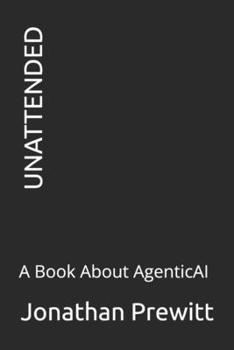
Unattended: A Book About AgenticAI

The vendor called it an agentic AI risk platform. The demo was impressive. The slides were clean. The room was nodding.
Then someone asked about the feedback loop.
There was no feedback loop. There was a rules engine with a language model on top, charged at enterprise pricing, deployed into a risk function that now believed it had autonomous intelligence watching its back. It did not.
This is the book for the practitioners who ask the feedback loop question. The ones who are genuinely enthusiastic about what agentic AI can do for risk management and deeply skeptical of what the market is currently selling as agentic AI. Those are not contradictory positions. In fact, holding both simultaneously is the only way to deploy these systems without getting burned.
Agentic AI is the most significant shift in risk management in a generation. It can monitor continuously, reason across thousands of data points simultaneously, act within defined authority without waiting for a human to initiate, and learn from outcomes in ways that make it more accurate over time. It addresses the three structural problems that have plagued risk programs for years: the volume problem, the attention problem, and the speed problem. No tool before it has addressed all three at once.
It is also being sold by people who have rebranded their workflow automation, slapped the word "agentic" on a chatbot, and priced accordingly. And the organizations buying it are deploying it into governance structures that were built for human-speed decision-making, governed by AI frameworks written by committees that have never deployed an agent, and managed by teams who have been told the system is handling the risk when the system is handling the reporting.
Unattended names what is actually happening. Agent Theater. Capability Cosplay. The Autonomous Accountability Void. Governance Taxidermy. Efficiency Theater. These are not hypothetical failure modes. They are the dominant conditions of the current market, and they are costing organizations the very capability they thought they were buying.
This book is for CISOs, risk leaders, GRC practitioners, and anyone responsible for deploying or overseeing agentic AI in a risk context. It is not a technology primer. It is not a vendor guide. It is a practitioner framework for understanding what these systems actually do, building governance that actually functions, managing vendor relationships that are categorically unlike any you have managed before, and deploying something that produces durable value rather than an impressive first quarter followed by a quiet organizational reckoning.
The agent is powerful. The governed agent is transformative. The unattended agent is a liability.
This book is about the difference.
Customer Reviews
ThriftBooks ® and the ThriftBooks ® logo are registered trademarks of Thrift Books Global, LLC
