


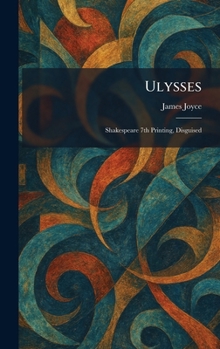
Ulysses: Shakespeare 7th Printing, Disguised

"Ulysses" is a landmark of modernist literature that chronicles a single day in the lives of ordinary Dubliners on June 16, 1904. Centered primarily on the experiences of Leopold Bloom, the narrative is meticulously structured to parallel Homer's "Odyssey," with each chapter corresponding to an episode from the ancient Greek epic. James Joyce utilizes a variety of experimental techniques, most notably the stream of consciousness, to delve into the inner thoughts, memories, and sensations of his characters.
Through the intellectual wanderings of Stephen Dedalus and the earthier reflections of Bloom, the work examines themes of identity, displacement, and the search for connection in the modern world. The novel reaches its climax in the celebrated final monologue of Molly Bloom, a virtuosic display of prose that captures the fluidity of human consciousness. As a masterpiece of linguistic innovation, "Ulysses" remains a foundational text of the 20th century, offering a profound and often humorous exploration of the human condition. Its rich allusions and complex wordplay continue to challenge and reward readers, making it an essential work of world literature.
This work has been selected by scholars as being culturally important, and is part of the knowledge base of civilization as we know it. This work was reproduced from the original artifact, and remains as true to the original work as possible. Therefore, you may see the original copyright references, library stamps (as most of these works have been housed in our most important libraries around the world), and other notations in the work.
This work is in the public domain in the United States of America, and possibly other nations. Within the United States, you may freely copy and distribute this work, as no entity (individual or corporate) has a copyright on the body of the work.
As a reproduction of a historical artifact, this work may contain missing or blurred pages, poor pictures, errant marks, etc. Scholars believe, and we concur, that this work is important enough to be preserved, reproduced, and made generally available to the public. We appreciate your support of the preservation process, and thank you for being an important part of keeping this knowledge alive and relevant.
Customer Reviews
ThriftBooks ® and the ThriftBooks ® logo are registered trademarks of Thrift Books Global, LLC
