


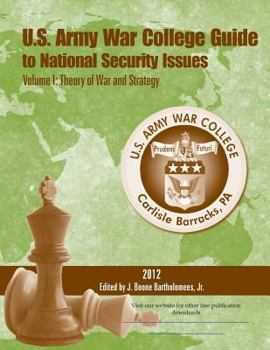
U. S. Army War College Guide to National Security Issues Volume I: THEORY OF WAR AND STRATEGY 5th Edition
No Customer Reviews

Colonel (Ret.) Arthur Lykke has taught an entire generation of U.S. Army War College students that strategy at any level consists of ends or objectives, ways or concepts, and means or resources. This three-element framework is nothing more than a reworking of the traditional definition of strategy as the calculated relationship of ends and means. Yet, the student response is always overwhelmingly favorable, with Lykke's framework invariably forming the structure for subse-quent seminar problems on subjects ranging from the U.S. Civil War to nuclear strategy. This is due, in part, to the fact that students weaned on the structural certitude of the five-paragraph field order and the Commander's Estimate naturally find such structure comforting in dealing with the complexities of strategy. But those students also know from their experience in the field that there are limits to the scientific approach when dealing with human endeavors. As a consequence, they can also appreciate the art of mixing ends, ways, and means, using for each element some subjec-tive and some objective criteria of suitability, feasibility, and applicability-the essence of strategic calculation.1The ends-ways-means paradigm also provides a structure at any level of strategy to avoid confusing the scientific product with the scientific process. The former involves production propo-sitions that are logically related and valid across time and space. The search for these immutable principles over the centuries by students of war failed, because they looked at classical strategy as something like physical science that could produce verities in accordance with certain regularities. This was further compounded by military thinkers who made claims for scientific products with-out subjecting those products to a scientific process. Both Jomini and Mahan, for instance, ignored evidence in cases that did not fit their theories or principles of strategy.2 The strategic paradigm, then, serves as a lowest common denominator reminder that a true scientific product is not pos-sible from the study of strategy. At the same time, however, that paradigm provides a framework for the systematic treatment of facts and evidence-the very essence of the scientific process. In this regard, Admiral Wylie has pointed out: I do not claim that strategy is or can be a 'science' in the sense of the physical sciences. It can and should be an intellectual discipline of the highest order, and the strategist should prepare himself to manage ideas with precision and clarity and imagination. Thus, while strategy itself may not be a science, strategic judgment can be scientific to the extent that it is orderly, rational, objective, inclusive, discriminatory, and perceptive
Format:Paperback
Language:English
ISBN:1539750892
ISBN13:9781539750895
Release Date:January 1
Publisher:Createspace Independent Publishing Platform
Length:360 Pages
Weight:1.84 lbs.
Dimensions:0.8" x 8.5" x 11.0"
Related Subjects
ReferenceCustomer Reviews
0 rating
Copyright © 2026 Thriftbooks.com Terms of Use
| Privacy Policy | Do Not
Sell/Share My Personal Information | Cookie Policy | Cookie Preferences | Accessibility Statement
ThriftBooks® and the ThriftBooks® logo are registered trademarks of Thrift Books Global, LLC
ThriftBooks® and the ThriftBooks® logo are registered trademarks of Thrift Books Global, LLC
