


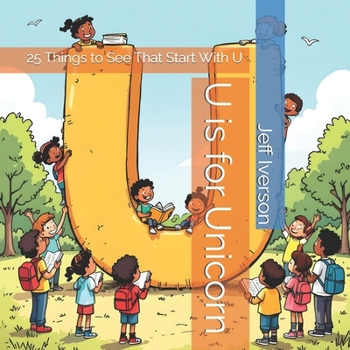
U is for Unicorn: 25 Things to See That Start With U

U Is for Unicorn is a playful, early-reader companion book that invites children ages 3-8 to explore the letter U through a curated collection of twenty-five kid-friendly words. Each entry introduces a simple concept, object, or idea beginning with U, paired with a short, accessible definition designed to spark curiosity, build vocabulary, and strengthen early literacy skills. The book blends everyday experiences, imaginative elements, and gentle science themes, giving young readers a wide range of things to recognize, wonder about, and talk through with adults.
The journey begins with Unicorn, a magical and inviting anchor word that sets a tone of wonder. From there, the book moves into familiar, concrete items like Umbrella, Uniform, Ukulele, and Utensils, helping children connect the letter U to objects they see in daily life. These entries reinforce recognition and confidence-kids can point to something in their world and proudly say, "That starts with U "
The book also introduces spatial and directional concepts such as Up, Under, Upstairs, and U-turn, giving young learners language for movement and position. These words support early math and logic skills, helping children describe where things are and how they move. Emotional and social learning appears through Uplift, which gently teaches kindness and encouragement in a way children can understand.
Nature and science themes expand the child's world further. Universe, Underwater, Upstream, Upland, Urchin, and Ultraviolet offer simple, approachable windows into astronomy, ecology, geography, and light. Each definition is crafted to be accurate yet friendly, giving children a foundation for future scientific understanding without overwhelming them.
Action-based words like Unzip, Unfold, Unpack, and Uproot highlight everyday motions and hands-on experiences. These entries help children connect language to physical actions, reinforcing comprehension through things they can do with their own hands. Unicycle and Upbeat add energy and playfulness, encouraging movement, music, and joy.
The book concludes with Udon and Universe Map, widening cultural and conceptual horizons. Udon introduces a food from another part of the world, while Universe Map ties back to the earlier astronomy entry, showing how pictures and diagrams help us understand big ideas.
Across all twenty-five entries, the structure remains consistent: a bold U-word followed by a single, clear sentence that defines it in language accessible to young readers. This predictable rhythm supports early reading confidence and makes the book ideal for classrooms, bedtime reading, and alphabet-themed learning activities. The simplicity of each definition also leaves ample room for illustration, inviting visual storytelling that can expand each concept beyond the text.
Overall, U Is for Unicorn is both a vocabulary builder and a gentle exploration guide. It blends imagination, real-world objects, emotional learning, and early science in a way that feels cohesive, friendly, and developmentally aligned. By the end, children gain not only a stronger grasp of the letter U but also a sense of discovery-seeing how many different kinds of things a single letter can hold.
Customer Reviews
ThriftBooks® and the ThriftBooks® logo are registered trademarks of Thrift Books Global, LLC
