


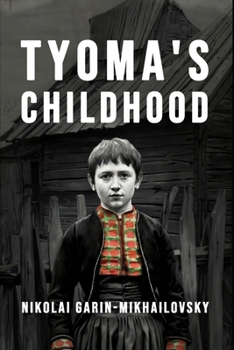
Tyoma's Childhood: A New Translation

Tyoma is eight years old, the son of a retired general in a provincial Russian town, and the world around him is large, confusing, and not always kind. His father's rages fill the house with a particular kind of silence. The rules of childhood - what is brave, what is shameful, what can be forgiven and what cannot - are constantly shifting beneath his feet. And one night, his dog Zhuchka falls into a well, and Tyoma must decide, alone in the dark, what he is made of.
Tyoma's Childhood, first published in 1892, is the opening volume of Nikolai Garin-Mikhailovsky's celebrated autobiographical tetralogy - a sequence that follows one life from its earliest bewilderments to the threshold of adulthood. It is also, on its own terms, one of the most psychologically honest portraits of childhood in nineteenth-century Russian fiction: clear-eyed about fear and shame and the slow, uneven business of forming a conscience, and written with the kind of close, unsentimental warmth that only genuine memory can produce.
Garin-Mikhailovsky was an engineer who helped survey the route of the Trans-Siberian Railway and a writer who could not stop looking back at where he had come from. In Tyoma, he found the beginning of the answer to a question that runs through all his work: what does it cost to become the person you eventually are? The boy in this novel is not innocent in any easy sense. He is something more interesting - a moral creature, stumbling toward himself, in a world that does not make it simple.
Warm, unsparing, and quietly unforgettable.
Customer Reviews
ThriftBooks ® and the ThriftBooks ® logo are registered trademarks of Thrift Books Global, LLC
