




Select Format
Select Condition 
Book Overview
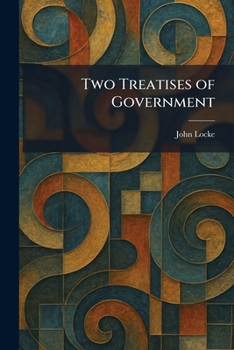
"Two Treatises of Government" is a seminal work of political philosophy that laid the foundations for modern liberal democracy and the principles of individual liberty. In this influential text, John Locke presents a rigorous defense of natural rights and the social contract, challenging the prevailing notions of absolute monarchy and the divine right of kings.
The first treatise serves as a detailed refutation of patriarchalism, systematically dismantling the argument that political authority is derived from a divinely ordained lineage. In the second treatise, Locke articulates his own vision of a legitimate civil government. He asserts that individuals in a state of nature are free and equal, and that they enter into a social contract to establish a government dedicated to the protection of their life, liberty, and property. Crucially, Locke argues that political power is held in trust, and that citizens maintain the right to dissolve a government that acts against their interests or violates their fundamental rights.
A cornerstone of Enlightenment thought, "Two Treatises of Government" continues to be essential reading for anyone seeking to understand the historical roots of constitutionalism, human rights, and the relationship between the state and the individual.
This work has been selected by scholars as being culturally important, and is part of the knowledge base of civilization as we know it. This work was reproduced from the original artifact, and remains as true to the original work as possible. Therefore, you may see the original copyright references, library stamps (as most of these works have been housed in our most important libraries around the world), and other notations in the work.
This work is in the public domain in the United States of America, and possibly other nations. Within the United States, you may freely copy and distribute this work, as no entity (individual or corporate) has a copyright on the body of the work.
As a reproduction of a historical artifact, this work may contain missing or blurred pages, poor pictures, errant marks, etc. Scholars believe, and we concur, that this work is important enough to be preserved, reproduced, and made generally available to the public. We appreciate your support of the preservation process, and thank you for being an important part of keeping this knowledge alive and relevant.
Customer Reviews
The Second Treatise and the American Founding
Most Representative Thinker in Anglo-American Tradition
Seminal
Going to the (Somewhat inconsistent) Source
Principles of liberty which inspired Tom Jefferson
ThriftBooks ® and the ThriftBooks ® logo are registered trademarks of Thrift Books Global, LLC
