
Skip to content
Scan a barcode
Scan
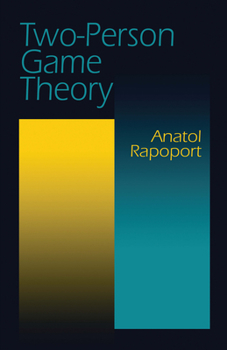
Paperback Two-Person Game Theory Book

ISBN: 0486406865

ISBN13: 9780486406862

Two-Person Game Theory

Select Format

Select Condition ThriftBooks Help Icon

Recommended

Format: Paperback

Condition: Good

$8.09
Save $4.86!
List Price $12.95
Almost Gone, Only 5 Left!
Save to List

Book Overview

"Game theory is an intellectual X-ray. It reveals the skeletal structure of those systems where decisions interact, and it reveals, therefore, the essential structure of both conflict and cooperation." -- Kenneth Boulding
This fascinating and provocative book presents the fundamentals of two-person game theory, a mathematical approach to understanding human behavior and decision-making, Developed from analysis of games of strategy such as chess, checkers, and Go, game theory has dramatic applications to the entire realm of human events, from politics, economics, and war, to environmental issues, business, social relationships, and even "the game of love." Typically, game theory deals with decisions in conflict situations.
Written by a noted expert in the field, this clear, non-technical volume introduces the theory of games in a way which brings the essentials into focus and keeps them there. In addition to lucid discussions of such standard topics as utilities, strategy, the game tree, and the game matrix, dominating strategy and minimax, negotiated and nonnegotiable games, and solving the two-person zero-sum game, the author includes a discussion of gaming theory, an important link between abstract game theory and an experimentally oriented behavioral science. Specific applications to social science have not been stressed, but the methodological relations between game theory, decision theory, and social science are emphasized throughout.
Although game theory employs a mathematical approach to conflict resolution, the present volume avoids all but the minimum of mathematical notation. Moreover, the reader will find only the mathematics of high school algebra and of very elementary analytic geometry, except for an occasional derivative. The result is an accessible, easy-to-follow treatment that will be welcomed by mathematicians and non-mathematicians alike.

Related Subjects

Math Mathematics Science & Math

Customer Reviews

2 ratings

A concise, colorful and illuminating introduction to two-players Game Theory

Definitely a must reading if you are interested in game theory, conflict resolution or behavioral science. This very enjoyable book is full of interesting and colorful examples to illustrate each covered topic. Rapoport combines an interesting and rare mix of skills: a mathematical expertise, an extensive and deep knowledge of behavioral science and an amenable writing style. The result is little-great book that knits together work in decision-making, psychology, strategic thinking and pure game theory. In this remarkable and illuminating text the relevant concepts are introduced in a very clear way. In the last chapter the author offers a critical review assessing strong and weaknesses of Game Theory for purposes of modeling human behavior and situations characterized by conflicts of interest. The main conclusion is a remarkable one: the great value of game theory is in its power to reveal its own incompleteness.

The starting point book for learning game theory

If you want to learn the underlying foundations of game theory, and do not want anything over-technical or under-technical in its explanation and description, then this is a good book to consider. Most introductory game theory books usually plunge you into the math immediately and the remaining few use very little of it and focus on the qualitative aspects. If you're looking for a book that can both teach you game theory and the math behind it, but assumes all you know is the math you know or remember was from high school, then Two-Person Game Theory is what you've been looking for. This book begins essentially with no usage of mathematical jargon whatsoever and slowly works in the math a little more each chapter. By the last third of the book, there is substantial use of math in each chapter, but by then it is understandable because of this slowly increasing dosage you've been exposed to while reading. In any case, the mathematical background requirements of the reader is minimal. For most of the book all you will encounter are basic concepts of probability, with some simple algebra and a few instances of calculus used in the later chapters, though these parts aren't integral for overall understanding if you're just getting into game theory. However, the author also provides a verbal account for the rationale and underlying logic for every mathematical equation and representation he introduces. Overall, this is an excellent introductory book, especially if you're intimidated by math but still want to learn about game theory and the math behind it.
Copyright © 2026 Thriftbooks.com Terms of Use | Privacy Policy | Do Not Sell/Share My Personal Information | Cookie Policy | Cookie Preferences | Accessibility Statement
ThriftBooks® and the ThriftBooks® logo are registered trademarks of Thrift Books Global, LLC

GoDaddy Verified and Secured
