


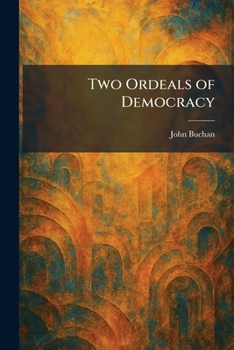
Two Ordeals of Democracy

"Two Ordeals of Democracy" is a profound exploration of the resilience and adaptability of democratic systems during times of immense national crisis. Written by the distinguished historian and statesman John Buchan, this work presents a comparative analysis of two of the most significant challenges to democratic governance in modern history: the American Civil War and the First World War.
Buchan examines the unique stresses that total war places upon a free society, investigating how leadership, public morale, and political institutions must evolve to survive existential threats. By drawing parallels between the struggles of the nineteenth century and the global conflict of the early twentieth century, the author provides a nuanced perspective on the inherent strengths and vulnerabilities of democratic states. The work highlights the spiritual and civic determination required to sustain a war effort while maintaining the core tenets of liberty and self-governance.
Valuable for students of political science and military history, "Two Ordeals of Democracy" offers a timeless meditation on statecraft and the survival of ideals. Buchan's authoritative and eloquent prose makes this an essential read for understanding the historical development of democratic thought and the capacity for nations to endure through their greatest trials.
This work has been selected by scholars as being culturally important, and is part of the knowledge base of civilization as we know it. This work was reproduced from the original artifact, and remains as true to the original work as possible. Therefore, you may see the original copyright references, library stamps (as most of these works have been housed in our most important libraries around the world), and other notations in the work.
This work is in the public domain in the United States of America, and possibly other nations. Within the United States, you may freely copy and distribute this work, as no entity (individual or corporate) has a copyright on the body of the work.
As a reproduction of a historical artifact, this work may contain missing or blurred pages, poor pictures, errant marks, etc. Scholars believe, and we concur, that this work is important enough to be preserved, reproduced, and made generally available to the public. We appreciate your support of the preservation process, and thank you for being an important part of keeping this knowledge alive and relevant.
Customer Reviews
ThriftBooks ® and the ThriftBooks ® logo are registered trademarks of Thrift Books Global, LLC
