


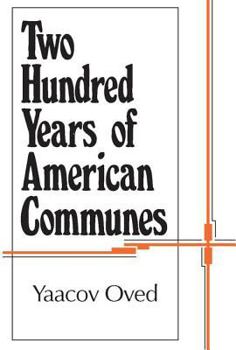
Two Hundred Years of American Communes

Select Format
Select Condition 
Book Overview
The United States is the only modern nation in which communes have continuously existed for the past two hundred years
Format:Paperback
Language:English
ISBN:1560006471
ISBN13:9781560006473
Release Date:January 1987
Publisher:Routledge
Length:516 Pages
Weight:1.55 lbs.
Dimensions:1.0" x 6.0" x 9.0"
Customer Reviews
1 rating
A DETAILED, INSIGHTFUL SURVEY OF COMMUNES IN AMERICA
Published by Thriftbooks.com User , 16 years ago
Yaacov Oved is s professor of history at Tel Aviv University. He wrote this quite detailed survey of various American communes in 1988, and explains, "I therefore decided to open my study with a description of the commmunes from the early days of the English colonies in North America until the 1930s, when there was a lull that ended in the 1960s. Since then modern communes have appeared, established by the children of the affluent society." His book contains much more detailed information than is usually found in such surveys, such as: The Ephrata community abolished private property, because "Owning private property was regarded as 'Ananias's sin.'" "The Shakers knew no racial discrimination. Ex-slaves could join, but only a few opted for a communal life." Although the Shakers took in orphans, "The source of absorbing external pupils from orphanages and broken families had dried up as well; only about 20 percent of all those who had been educated in Shaker settlements joined them." Bethel "had no definite tenets, since Keil refused to formulate any theories. He regarded the Bible as their theoretic foundation and maintained that their communal practices should grow spontaneously. This characterized Bethel as one of the few communes that never defined any regulations and was thus never legalized by state authorities. They remained a 'voluntary association' to the end." Oved notes that once Oneida reverted back to monogamy, "The combination of retreat from complex marriage, the return to a monogamous family system, and at the same time maintaining the integrity of the community based on economic communalism, did not work. The internal cohesion that had been undermined and the acquisitive instincts that were acutely manifested among the newly established families prevented the functioning of the commune as envisoned by John Humphrey Noyes's proposals. Soon voices clamored to retreat from communism as well." "Llano's greatest communitarian achievement was its highly satisfying social, cultural, and intellectual life.... the commune never neglected activities of a cultural nature: debating societies, study groups, art classes, recreational activities, community singing, a choir, an orchestra, and a drama circle provided a varied fare." "Most communes were closed and selective communities. Only a few had an open door policy." "In spite of these drawbacks, we can still say that the status of women on communes was higher than the average in most American communities of that time. It was no coincidence that the women who were actively involved with the movement for women's rights---Francis Wright and Margaret Fuller---were involved with the communes." He concludes that "a comprehensive and comparative survey of the breakup of communes does not point to the existence of a single course that repeats itself in all the communes as a regular and predictable process."
Copyright © 2026 Thriftbooks.com Terms of Use
| Privacy Policy | Do Not
Sell/Share My Personal Information | Cookie Policy | Cookie Preferences | Accessibility Statement
ThriftBooks® and the ThriftBooks® logo are registered trademarks of Thrift Books Global, LLC
ThriftBooks® and the ThriftBooks® logo are registered trademarks of Thrift Books Global, LLC
