


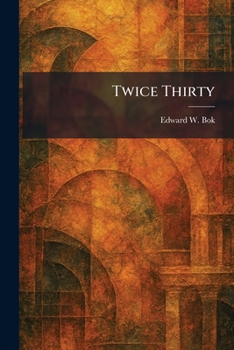
Twice Thirty

Select Format
Select Condition 
Book Overview
"Twice Thirty" is a reflective and insightful memoir by Edward W. Bok, written as he reached the significant milestone of sixty years of age. Serving as a companion and follow-up to his Pulitzer Prize-winning autobiography, this work offers a deeper, more philosophical exploration of the author's life and the principles that guided his remarkable career. Bok, the long-time editor of the "Ladies' Home Journal", shares a collection of personal anecdotes and observations that he calls "short and simple annals of the road."
The narrative traces his journey from his roots as a Dutch immigrant to his rise as a titan of the American publishing industry. Through engaging prose, Bok examines the changing landscape of American society at the turn of the century and his interactions with the leading figures of his day. Unlike a standard chronological biography, "Twice Thirty" focuses on the wisdom gained through experience, emphasizing themes of character, service, and the pursuit of excellence. It provides a unique window into the mind of a man who helped shape the cultural tastes of a nation, making it a valuable resource for readers interested in the history of journalism, the immigrant experience, and the development of American identity.
This work has been selected by scholars as being culturally important, and is part of the knowledge base of civilization as we know it. This work was reproduced from the original artifact, and remains as true to the original work as possible. Therefore, you may see the original copyright references, library stamps (as most of these works have been housed in our most important libraries around the world), and other notations in the work.
This work is in the public domain in the United States of America, and possibly other nations. Within the United States, you may freely copy and distribute this work, as no entity (individual or corporate) has a copyright on the body of the work.
As a reproduction of a historical artifact, this work may contain missing or blurred pages, poor pictures, errant marks, etc. Scholars believe, and we concur, that this work is important enough to be preserved, reproduced, and made generally available to the public. We appreciate your support of the preservation process, and thank you for being an important part of keeping this knowledge alive and relevant.
Customer Reviews
ThriftBooks ® and the ThriftBooks ® logo are registered trademarks of Thrift Books Global, LLC
