


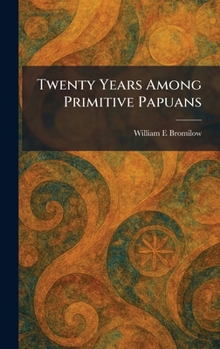
Twenty Years Among Primitive Papuans

"Twenty Years Among Primitive Papuans" is a compelling firsthand account of the life and labors of William E. Bromilow, a pioneering Methodist missionary in the late 19th and early 20th centuries. The narrative documents two decades spent on Dobu Island and throughout the D'Entrecasteaux Archipelago in Papua New Guinea. Bromilow offers a detailed look at the initial encounters between Western missionaries and the indigenous Papuan peoples, providing invaluable ethnographic observations of local customs, social structures, and spiritual beliefs.
The work serves as both a spiritual memoir and a historical record of cultural transition. Readers will find vivid descriptions of the challenges faced by early mission teams, the process of linguistic translation-notably Bromilow's work on the Dobu Bible-and the complex shifts in communal practices as Christianity was introduced to the region. Rich in detail regarding traditional warfare, sorcery, and tribal ceremonies, "Twenty Years Among Primitive Papuans" remains a significant primary source for those interested in the history of Oceania, the evolution of global missions, and the early anthropological study of Melanesian societies. This volume captures a transformative era in the Pacific, reflecting the deep dedication of its author and the resilience of the communities he served.
This work has been selected by scholars as being culturally important, and is part of the knowledge base of civilization as we know it. This work was reproduced from the original artifact, and remains as true to the original work as possible. Therefore, you may see the original copyright references, library stamps (as most of these works have been housed in our most important libraries around the world), and other notations in the work.
This work is in the public domain in the United States of America, and possibly other nations. Within the United States, you may freely copy and distribute this work, as no entity (individual or corporate) has a copyright on the body of the work.
As a reproduction of a historical artifact, this work may contain missing or blurred pages, poor pictures, errant marks, etc. Scholars believe, and we concur, that this work is important enough to be preserved, reproduced, and made generally available to the public. We appreciate your support of the preservation process, and thank you for being an important part of keeping this knowledge alive and relevant.
Customer Reviews
ThriftBooks ® and the ThriftBooks ® logo are registered trademarks of Thrift Books Global, LLC
