


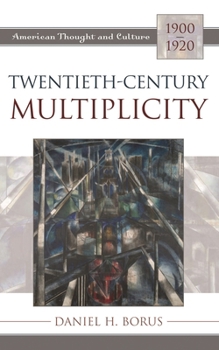
Twentieth-Century Multiplicity: American Thought and Culture, 1900-1920
No Customer Reviews

Select Format
Select Condition 
Book Overview
Twentieth-Century Multiplicity explores the effect of the culture-wide sense that prevailing syntheses failed to account fully for the complexities of modern life. As Daniel H. Borus documents the belief that there were many truths, many beauties, and many values--a condition that the historian Henry Adams labeled multiplicity--rather than singular ones prompted new departures in a myriad of discourses and practices ranging from comic strips to politics to sociology. The new emphasis on contingency and context prompted Americans to rethink what counted as truth and beauty, how the self was constituted and societies cohered and functioned. The challenge to absolutes and universals, Borus shows, gave rise to a culture in which standards were not always firm and fixed and previously accepted hierarchies were not always valid. Although itself strenuously challenged, especially during the First World War, early twentieth-century multiplicity bequeathed to American cultural life an abiding sense of the complexity and diversity of things.
Format:Paperback
Language:English
ISBN:0742515079
ISBN13:9780742515079
Release Date:December 2011
Publisher:Rowman & Littlefield Publishers
Length:328 Pages
Weight:1.50 lbs.
Dimensions:1.0" x 5.9" x 8.9"
Customer Reviews
0 rating
Copyright © 2026 Thriftbooks.com Terms of Use
| Privacy Policy | Do Not
Sell/Share My Personal Information | Cookie Policy | Cookie Preferences | Accessibility Statement
ThriftBooks® and the ThriftBooks® logo are registered trademarks of Thrift Books Global, LLC
ThriftBooks® and the ThriftBooks® logo are registered trademarks of Thrift Books Global, LLC
