


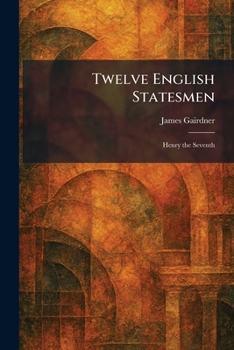
Twelve English Statesmen: Henry the Seventh

"Twelve English Statesmen: Henry the Seventh" provides a comprehensive biographical analysis of the first Tudor monarch, a pivotal figure who bridged the gap between the medieval and modern eras of English history. Written by the esteemed historian James Gairdner, this scholarly work examines the life and reign of a king who successfully ended the devastating Wars of the Roses and established a new era of stability and centralized authority in England.
The book explores the strategic depth of Henry VII's reign, focusing on his cautious yet effective diplomacy, his meticulous financial administration, and his persistent efforts to secure the throne against numerous pretenders. Gairdner delves into the King's character, portraying him as a sagacious and far-seeing ruler whose administrative reforms laid the essential foundations for the future greatness of the Tudor dynasty. This volume serves as an invaluable resource for readers interested in British constitutional history, the evolution of the monarchy, and the complex political landscape of the late 15th and early 16th centuries. Through a detailed and engaging narrative, Gairdner provides a window into the statecraft and personal influence of the man who fundamentally redefined the English state.
This work has been selected by scholars as being culturally important, and is part of the knowledge base of civilization as we know it. This work was reproduced from the original artifact, and remains as true to the original work as possible. Therefore, you may see the original copyright references, library stamps (as most of these works have been housed in our most important libraries around the world), and other notations in the work.
This work is in the public domain in the United States of America, and possibly other nations. Within the United States, you may freely copy and distribute this work, as no entity (individual or corporate) has a copyright on the body of the work.
As a reproduction of a historical artifact, this work may contain missing or blurred pages, poor pictures, errant marks, etc. Scholars believe, and we concur, that this work is important enough to be preserved, reproduced, and made generally available to the public. We appreciate your support of the preservation process, and thank you for being an important part of keeping this knowledge alive and relevant.
Customer Reviews
ThriftBooks ® and the ThriftBooks ® logo are registered trademarks of Thrift Books Global, LLC
