


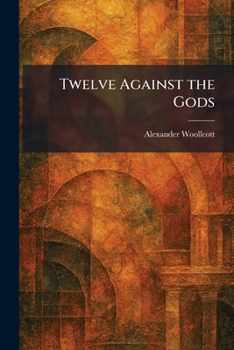
Twelve Against the Gods

Select Format
Select Condition 
Book Overview
"Twelve Against the Gods" is an insightful and compelling study of twelve historical figures who dared to challenge the established order of their times. The work examines the lives of diverse individuals-ranging from world conquerors and explorers to political leaders and social rebels-defining them through the lens of the "adventurer." By exploring the motivations and fates of figures such as Alexander the Great, Casanova, and Christopher Columbus, the text provides a profound meditation on the conflict between individual will and the forces of destiny.
Each profile serves as a psychological portrait, capturing the internal drive and external pressures that led these individuals to transcend the ordinary. The narratives balance historical facts with evocative prose, offering a timeless perspective on what it means to live life on the edge of the known world. "Twelve Against the Gods" is more than a collection of biographies; it is a philosophical inquiry into the nature of risk, ambition, and the human desire to leave an indelible mark on history. It remains an essential read for those interested in the complexities of the human spirit and the historical impact of those who refuse to conform.
This work has been selected by scholars as being culturally important, and is part of the knowledge base of civilization as we know it. This work was reproduced from the original artifact, and remains as true to the original work as possible. Therefore, you may see the original copyright references, library stamps (as most of these works have been housed in our most important libraries around the world), and other notations in the work.
This work is in the public domain in the United States of America, and possibly other nations. Within the United States, you may freely copy and distribute this work, as no entity (individual or corporate) has a copyright on the body of the work.
As a reproduction of a historical artifact, this work may contain missing or blurred pages, poor pictures, errant marks, etc. Scholars believe, and we concur, that this work is important enough to be preserved, reproduced, and made generally available to the public. We appreciate your support of the preservation process, and thank you for being an important part of keeping this knowledge alive and relevant.
Customer Reviews
ThriftBooks ® and the ThriftBooks ® logo are registered trademarks of Thrift Books Global, LLC
