


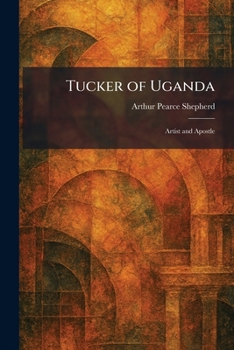
Tucker of Uganda: Artist and Apostle

"Tucker of Uganda: Artist and Apostle, 1849-1914" offers a compelling account of the life and legacy of Alfred Robert Tucker, one of the most influential figures in the history of East African missions. Written by A. P. Shepherd, this biography traces Tucker's remarkable journey from a talented professional artist to the Bishop of Uganda, a role he held during a transformative period for the region and its people.
The work explores Tucker's deep commitment to the establishment of an indigenous church, his advocacy for the rights of the Ugandan people, and his pivotal role in navigating the complex political and social landscapes of the late nineteenth and early twentieth centuries. His artistic background provided a unique lens through which he viewed his surroundings, and his dedication to his faith left an indelible mark on the development of Christianity in Africa. Readers interested in missionary history, colonial-era East Africa, and the intersection of faith and leadership will find this narrative both illuminating and inspiring. "Tucker of Uganda: Artist and Apostle, 1849-1914" serves as a vital record of a man whose vision helped shape the religious and cultural identity of the region.
This work has been selected by scholars as being culturally important, and is part of the knowledge base of civilization as we know it. This work was reproduced from the original artifact, and remains as true to the original work as possible. Therefore, you may see the original copyright references, library stamps (as most of these works have been housed in our most important libraries around the world), and other notations in the work.
This work is in the public domain in the United States of America, and possibly other nations. Within the United States, you may freely copy and distribute this work, as no entity (individual or corporate) has a copyright on the body of the work.
As a reproduction of a historical artifact, this work may contain missing or blurred pages, poor pictures, errant marks, etc. Scholars believe, and we concur, that this work is important enough to be preserved, reproduced, and made generally available to the public. We appreciate your support of the preservation process, and thank you for being an important part of keeping this knowledge alive and relevant.
Customer Reviews
ThriftBooks ® and the ThriftBooks ® logo are registered trademarks of Thrift Books Global, LLC
