


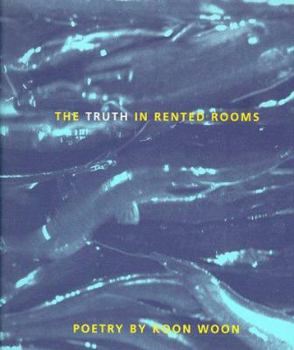
The Truth In Rented Rooms


Typed out in cramped tenements or scrawled on bits of paper, Koon Woon's impulsive startling poetry probes the lonely world of itinerants and the dispossed found in the shadows of immigrant life in... This description may be from another edition of this product.
Format:Paperback
Language:English
ISBN:1885030258
ISBN13:9781885030252
Release Date:October 1998
Publisher:Kaya/Muae
Length:120 Pages
Weight:0.35 lbs.
Dimensions:7.5" x 0.5" x 6.3"
Related Subjects
PoetryCustomer Reviews
4 ratings
Tenant Laws - From The Raven Chronicles
Published by Thriftbooks.com User , 24 years ago
The fantasy of self reliance doesn?t just include the retreat to nature of Ralph Emerson or Ted Kosynski but it also includes the more urban counterparts of the bare bones existences lived out of a single room in a cheap hotel of Jesse Bernstein or Koon Woon; a plain trust of where they are right then despite the evidence that their current state of mind and health is not a permanent one and may come apart at any moment. Koon Woon?s narrator lives in the temporary housing of an unstable mind. He organizes these poems In The Truth of Rented Room around International District dives?the names of which sound to me like vaguely familiar but exotic locales that a troubled cousin or family friend (some vague and distant acquaintance) may have lived in once but are familiar nonetheless as places where terminal failures end up like the layers of hell; Seventh Avenue South, the Morris, International Terrace, The Bush, and so have this downward appeal and even romance as places where you earn your way in with failure. This is the contemporary edge of that old, bad Seattle neighborhood, Skid Road, home to destitute madmen and hobos. And the poems in The Truth in Rented Rooms are mad poems. Mad because insanity is not mental illness or bipolar disorder or any vague and undefined malady that can be cured. Even normal people are possessed by madness but it is only contained and treated with the metal walkers of medication but it cannot be burned out of the body with radiation or dispelled with penicillin. Madness is an irrevocable state of being. Everyone has some access to the idea of madness and I?m not talking about the cartoon of Bugs Bunny?s windwheel eyes but the real dead-weight that comes about in deep depression when the air because it is too wet and too cold takes too much effort to shovel into your lungs. And this isn?t exactly Walden. In this wilderness holes have been burnt into the brain, bits chewed out cell by cell by whatever forces have rewired the synapses like the topography of a flooding river?s sand bars and channels. The narrator of Koon Woon?s poems has reconciled his state of being as something to live with like an independent element, wind and rain and whatever weather is going on inside his skull. These are not hopeful poems about recovery or conquering his condition. I found in these poems a broader acceptance of life?s instability, heightened by the transient nature of the narrator?s mind as well as his bed in rented rooms. This is self reliance not in the control of his environment but self-reliance in the acquiescence of control, which isn?t giving-up, but is the art of getting by. In, ?I have argued my premise of isolation and sorrow: the world comes into the pallor of my room?, Koon Woon writes:It took 10 years and the destruction of 6? x 4? x 4 ? or 96 cubic feet of poetry and 10 years to make me feel better, And I have now moved into a bigger room, room enough to blues the guitar,Have now room for Nietszche and Immanual Kant
Debut collection introducing the poetic talents of Koon Woon
Published by Thriftbooks.com User , 25 years ago
The Truth In Rented Rooms is the debut collection introducing the poetic talents of Koon Woon. The poetry is drawn from the streets of Seattle's International District, to rural China, to outer space. Woon's verse arises from his battles with mental illness, his year of life on the streets, and the need for an outlet to express the feelings he was having to control during those times. The Woman In The Next Room: Has a craving for a banana/And is convinced I am a spy after her secret.//She's reading one of those paperback books where/The heroine leads a successful double life.//She works in a doctor's office/And she flies to Florida under a year to read//A book in this next hotel room/And is worried about the minimum upkeep of a spy/Which I am. I know she rinses her lettuce/Many times and she has a secret kept in a semi-/Precious gem box no one can see or open./She is slender and naked upon the hotel bed/Just reading while the potted ferns tremble/Because someone has closed a door down the hall.//We come to this hotel once a year and live/In two adjacent hotel rooms and I pretend//I don't know her and she wants me to call her/On the telephone and talk to her about stocks and real estate.
Wry, funny, and clear-eyed
Published by Thriftbooks.com User , 26 years ago
It's brave and lucid stuff, this book. This is the kind of poetry that can hold you together on a bad day.I first learned about Koon Woon's poetry when he read at the annual meeting of the Washington State Tenants Union. If you ever have a chance to hear him read, be sure not to miss it. His delivery is natural, engaging, and free of that all-too-usual poetical pomposity.
A collection of witty, compassionate and humble poems.
Published by Thriftbooks.com User , 27 years ago
(This appeared in Oct. 98 issue - vol. 5, No. 10 - of Real Change Newspaper) Koon Woon told the audience at Open Books bookstore in Wallingford on a recent night that poetry was the only thing that held him together after mental illness ended his hopes of a career in science or mathematics. Woon was there to read in celebration of his first book of poems, The Truth in Rented Rooms, published by New York City's Kaya Press. Woon's writing displays none of the solipsism, complaints, and self-pity sometimes associated with poetry as self-help. On the contrary, the book is full of sharp-eyed observations of the human condition, great compassion, and moments of sly humor, as in the poem "How to Cook Rice," which includes the advice: "...Now place lid on top/ and reduce heat to medium, go read your newspaper/ until you get to the comics, then come back and turn it down to low./ The heat has been gradually traveling from the outside/ to the inside of the rice, giving it texture;/ a similar thing happens with people, I suppose./ Go back to your newspaper, finish the comics, and read/ the financial page. Now the rice is done..." Woon never let's the humor overshadow the compassion, though. Before wrapping up the poem with a final comic turn, he reminds us: "...before/ you eat, consider the peasant who arcs in leech-infested/ paddies and who carefully plants the rice seedlings/ one by one, and this night you are eating better than he." The book is divided into three sections: "7th Avenue South (1985 - 1992)," "The Morrison (1993 - 1996)" and "International Terrace (1996 - 1998)," according to Woon's place of residence at the time of composition. The terrain covered within the work is still broader than these three Seattle locations, with poems set in Aberdeen, where Woon grew up, and a number of poems that deal with life in the small village near Canton, in China, where he was born and lived until the age of eleven. One of these, "In Water Buffalo Time," is possibly the most moving poem in the collection. Two thirds of the way into it, in a passage reminiscent of Whitman, the narrator takes on the persona of a water buffalo and considers the differences between men and beasts: "Yet a man, with all his skill on an abacus, is afraid/ Of things he cannot see. The man and his family/ Are afraid of dark, gloomy gods handed down to them/ And buy copious amounts of incense and charms./ My mother, whose teats I suckled for only a brief while,/ Gave me no such gods of thunder to fear.// I don't even fear tigers. A man is cursed with worry:/ Thieves because he has too much, fires because he is careless,/ And ghost because he offends others./ But I, with the gold-pleated sky for a blanket,/ Sweet-smelling rice straw for a bed, a breeze from the river,/ I have recompense for my toil, with the village symphony/ Of crickets, cicadas, and bullfrogs,/ I shall say beasthood is as good as Buddhahood." A
Copyright © 2026 Thriftbooks.com Terms of Use
| Privacy Policy | Do Not
Sell/Share My Personal Information | Cookie Policy | Cookie Preferences | Accessibility Statement
ThriftBooks® and the ThriftBooks® logo are registered trademarks of Thrift Books Global, LLC
ThriftBooks® and the ThriftBooks® logo are registered trademarks of Thrift Books Global, LLC
