


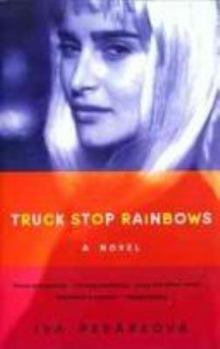
Truck Stop Rainbows

Select Format
Select Condition 
Book Overview
Combining adventure and scathing social commentary, unforced pathos and irrepressible eroticism. Truck Stop Rainbows is a surprising look at the children of Marx and Coca-Cola who are transforming the... This description may be from another edition of this product.
Format:Paperback
Language:English
ISBN:0679746757
ISBN13:9780679746751
Release Date:January 1994
Publisher:Knopf Doubleday Publishing Group
Length:279 Pages
Weight:0.55 lbs.
Dimensions:0.6" x 5.2" x 8.0"
Customer Reviews
4 ratings
Intelligent and thought-provoking
Published by Thriftbooks.com User , 26 years ago
Petarkova is the best-kept secret of modern literature. She intelligently reports on life in Socialist Czechoslovakia, while telling a compelling story of a young wman trying to find her way. This book is so beautiful! Gush, gush, gush, they should have you read this in high school after "1984."
Too bad I can't give this magnificent work a sixth star!
Published by Thriftbooks.com User , 27 years ago
By combining Kundera's sexual politics, the morality of Klima and Capek, Skvorecky's anti-communism, and Hrabal's anti-hero, Pekarova proves herself a worthy member of modern Czech literature. Her anti-heroine, Fialka, is cast into a kafkaesque world, bordered by an old fashioned grandmother, national boundaries, and a socialist bureaucracy worthy of dear Franz himself. The author merits recognition on par with Kerouac and Woodie Guthrie for her engrossing road novel. Fans of Czech literature will not be disappointed. If only Ms. Pekarova wrote in other than a "minor language".
In the Grand Tradition
Published by Thriftbooks.com User , 28 years ago
While I'm not as effusive as Joanna, I'm not as jaded as the reviewer from the Kirkus Reviews. I enjoyed the novel as a realistic and interesting glimpse into Czechoslovakia, and by proxy all of Soviet-dominated Eastern Europe, on the eve of glasnost. Pekarkova is a worthy successor to writers like Kundera and Hrabal with her penchant for political satire mixed with lush sensuality.
Czech woman gives communism the finger.
Published by Thriftbooks.com User , 29 years ago
The grim, gray realities of Communism suppressed the individualism, the rainbow of colors inherent in human beings. In Iva Pekarkova's "Truck Stop Rainbows," however, one woman, Fialka Jourova, wages her own battle not only to defy communism but to give it the finger.Fialka, a young Czech woman, is trapped, confined academically and socially as well as physically. She studies at university, but only what the Communist regime will allow, Soviet renditions of Western thoughts and writings. She lives with decay and paralysis. The two people closest to her are her aging, decrepit grandmother and her best friend, Patrik, who has multiple sclerosis.Her grandmother, a hypnotized zombie, sits dull-eyed, watching endless hours of mindless Communist-approved television. The alienation she feels from her grandmother is not different from what she feels from her peers, who are uniformally and mindlessly channeled to conform to the Party Line. They study, date, marry, and procreate so as not to interefere with the workings of the system. She and Patrik stand out among these pod people.Although Patrik's mind and soul are immune to the deadening, numbing effects of the system, his body succombs to the ravages of multiple sclerosis. His struggle to maintain his physical and mental independence parallels Fialka's need to transcend her physical handicap, the Iron Curtain. Just as the authorities have appropriated the papers which will allow her to travel, they have made the acquisition of a wheelchair for Patrik impossible. Both Patrik and Fialka need wheels to escape the inevitability of another suffocating and stultifying Soviet tomorrow.Fialka's sexuality is the only weapon she has against the system. Hitchhiking along the Czech highways, she literally "fucks" the Western truck drivers and figuratively does so to the system. Through this intercourse - again, both literal and figurative - she not only gains forbidden knowledge about the free world but receives marketable products which she later sells to finance Patrik's liberation, a wheelchair.But what about Fialka? She fights windmills and procures wheelchairs, but sacrifices herself in the process. Hiding herself under layers of clown-like makeup as well as the countless bodies of truckers, she gives up her own personal rainbows, becoming another kind of victim of society. She realizes, finally, that her body and soul are not separable. When she rids herself of her constant paranoia, the probing claws of Communism, she no longer needs the wheels of Western trucks to liberate her. Although she thinks she can transcend her soiciety as well as her own sense of morality, she can't. And I feel a profound sense of relief
Copyright © 2026 Thriftbooks.com
Terms of Use | Privacy Policy | Do Not Sell/Share My Personal Information | Cookie Policy | Cookie Preferences | Accessibility Statement
ThriftBooks ® and the ThriftBooks ® logo are registered trademarks of Thrift Books Global, LLC
ThriftBooks ® and the ThriftBooks ® logo are registered trademarks of Thrift Books Global, LLC
