


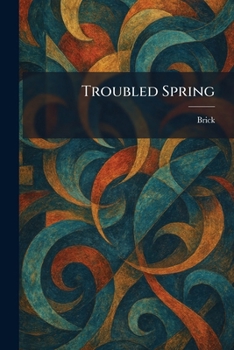
Troubled Spring

Select Format
Select Condition 
Book Overview
"Troubled Spring" is a poignant and evocative work of fiction that captures the restlessness and complexity of the human spirit during a period of profound social transition. Set against the backdrop of a changing world in the late 1920s, the narrative delves into the lives of characters struggling to reconcile their personal desires with the expectations of a society in flux. The title serves as a metaphor for the internal and external conflicts that arise when the stability of the past meets the uncertain currents of a modernizing future.
Through nuanced character studies and atmospheric prose, "Troubled Spring" explores themes of identity, longing, and the inevitable passage of time. The work reflects the distinct literary sensibilities of its era, blending psychological depth with keen observations of contemporary manners and morals. As the protagonists navigate emotional landscapes as volatile as the season itself, the book offers a timeless reflection on the universal challenges of finding one's place in an ever-evolving world. This narrative stands as a compelling example of early 20th-century storytelling, valued for its atmospheric depth and its sensitive examination of the human condition.
This work has been selected by scholars as being culturally important, and is part of the knowledge base of civilization as we know it. This work was reproduced from the original artifact, and remains as true to the original work as possible. Therefore, you may see the original copyright references, library stamps (as most of these works have been housed in our most important libraries around the world), and other notations in the work.
This work is in the public domain in the United States of America, and possibly other nations. Within the United States, you may freely copy and distribute this work, as no entity (individual or corporate) has a copyright on the body of the work.
As a reproduction of a historical artifact, this work may contain missing or blurred pages, poor pictures, errant marks, etc. Scholars believe, and we concur, that this work is important enough to be preserved, reproduced, and made generally available to the public. We appreciate your support of the preservation process, and thank you for being an important part of keeping this knowledge alive and relevant.
Customer Reviews
ThriftBooks ® and the ThriftBooks ® logo are registered trademarks of Thrift Books Global, LLC
