


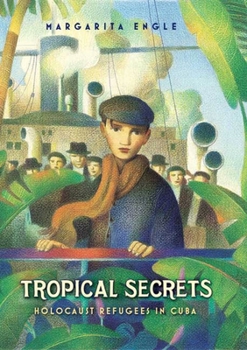
Tropical Secrets: Holocaust Refugees in Cuba

Select Format
Select Condition 
Book Overview
Daniel has escaped Nazi Germany with nothing but a desperate dream that he might one day find his parents again. But that golden land called New York has turned away his ship full of refugees, and Daniel finds himself in Cuba. As the tropical island begins to work its magic on him, the young refugee befriends a local girl with some painful secrets of her own. Yet even in Cuba, the Nazi darkness is never far away . . .
Format:Hardcover
Language:English
ISBN:0805089365
ISBN13:9780805089363
Release Date:March 2009
Publisher:Henry Holt & Company
Length:208 Pages
Weight:0.76 lbs.
Dimensions:0.7" x 5.7" x 8.6"
Age Range:12 to 18 years
Grade Range:Grade 7 to Postsecondary
Customer Reviews
2 ratings
Sydney Taylor Book Award Winner for Teen Readers - 2010
Published by Thriftbooks.com User , 16 years ago
The unusual topic of the plight of Holocaust refugees is told from the perspective of several characters, each with a distinct voice. Engle's evocative language in this beautifully crafted story is an outstanding example of the novel in verse genre. Daniel is a young refugee who hopes to find his parents, but his sense of despair and lonliness as he arrives in Cuba is heartbreaking. His words pull the reader in from the fist page. Last year in Berlin, on the Night of Crystal, my grandfather was killed while I held his hand...How can hatred have such a beautiful name? Crystal should be clear, but on that night the glass of broken windows did not glitter. A reader cannot finish the page without a visceral response. Paloma is the daughter of a shipping Lord who controls the refugees and profits from their entry. She lives in the dovecoat of her castle, with the birds, sneakily helps the refugees, and longs for her mother who has abandoned the family. She befriends Daniel, along with David. David is also a Jewish refugee who has made a life selling ice cream in Cuba. Through their voices, the political dynamics of Cuba after the war are revealed. The backdrop of Cuban culture is also shared through descriptions of people, places, and cultural celebrations. With friendship and the passage of time, David begins to heal, and so does Paloma. This breathtaking book pays homage to refugees of Cuba and those who supported them. Not only will readers learn about a little discussed historical event, they will fully engage in a beautifully told story whose characters resonate long after the last page is read. - BARBARA BIETZ - OAK PARK, CA
Havana central
Published by Thriftbooks.com User , 16 years ago
If children's authors were given superpowers upon the occasion of their first publication, I know what Margarita Engle's would be. Stealth. She's the kind of author you never see coming. You can pick up a book of hers, be it "The Poet Slave of Cuba" or "The Surrender Tree" and you'll never see her wordplay coming. She plays fair, of course. From page one onward you see exactly what you're getting yourself into, sometimes as early as the first line. What you took to be the poor man's version of a novel (the verse novel sometimes fails to get the appropriate amount of respect it deserves) instead has taken a board with a nail in it and is now systematically whacking you in the heart with its text. In the case of Ms. Engle, Cuba serves as her muse, and not in the way you might expect (see: Castro). Through her books kids are learning about historical aspects of Cuba that you simply cannot find anywhere else in juvenile lit. She's already tackled slavery in "The Poet Slave of Cuba" and the war of independence from Spain "The Surrender Tree". Now comes the most child-friendly of her novels. Don't mistake the term "child-friendly" with "simplistic", though. Perhaps the best plotted and conceived of her novels, Engle writes her most touching tribute to Cuba yet. As a place where all people with an inclination have found their own true home. He was meant to wind up in New York. That was the plan. When Daniel's parents spent all their money buying their son a ticket out of Nazi Germany, the idea was for him to disembark in Manhattan and meet his parents eventually there once they could get across. Instead, his ship was denied access to disembark in America, and sailed south to Cuba. Determined not to forget his parents, Daniel is so committed to his dream that he even has difficulty even parting with his hot winter clothing during the sultry Cuban days. While there he meets and befriends Paloma. Daughter of a corrupt Cuban official leeching money off the refuges, Paloma spends most of her days in her dovecote, living with the birds. The two kids are also friends with David, a Jewish man who once fled Russia, and who gives Daniel the advice and friendship he needs to move on. Secrets are revealed, friendships strengthened, and Daniel finds a way of living without merely going through the motions. You pay your money for a Margarita Engle book and what do you expect in return? Words words words. You want to see a woman at her craft, and "Tropical Secrets" will provide. There are lines like "I am thirteen, a young man, / but today I feel / like a baby seagull / with a broken beak." It's particularly sweet when you consider that later he will befriend Paloma, a girl who would care for such a bird. My plucking that line out of context does little to diminish its feel. Just look at these lines as I remove them from the story and tell them to stand on their own: "I have nothing to say / to any stranger who treats me / like a normal p
Copyright © 2026 Thriftbooks.com Terms of Use
| Privacy Policy | Do Not
Sell/Share My Personal Information | Cookie Policy | Cookie Preferences | Accessibility Statement
ThriftBooks® and the ThriftBooks® logo are registered trademarks of Thrift Books Global, LLC
ThriftBooks® and the ThriftBooks® logo are registered trademarks of Thrift Books Global, LLC
