


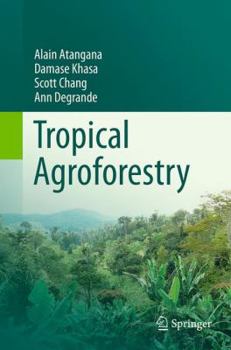
Tropical Agroforestry

Select Format
Select Condition 
Book Overview
Preface.- Acknowledgements.- Table of Contents.- List of Figures.- List of Tables.- Part I: Tropical Biomes, Land Use Issues and Introduction to Agroforestry Systems.- 1. Tropical biomes: classification and description.- 1.1. Classification of biomes based on climate.- 1.1.1. The K?ppen-Geiger classification system.- 1.1.2. The Holdridge life zones system.- 1.2. Other classification systems of biomes.- 1.2.1. Forest classification according to plant species.- 1.2.2. Forest classification based on soil nutrient status.- 1.2.3. Forest classification based on function.- 1.2.4. Classification of semiarid tropical biomes.- 1.3. Main tropical humid and semiarid biomes.- 1.3.1. Congo basin rain forests.- 1.3.2. Central and South American rain forests.- 1.3.3. Southeast Asian tropical rain forests.- 1.3.4. Australian savannas.- 1.3.5. African savannas.- 1.3.6. Central American and Caribbean Islands savannas.- 1.3.7. South American savannas.- 2. The importance of tropical forest and semiarid ecosystems.- Bibliography.- 2: Major Land Use Issues in the Tropics, and the History of Agroforestry.- Abstract.- Introduction.- 2.1. Impacts of traditional natural resource use on tropical ecosystems.- 2.1.1. Deforestation.- 2.1.2. Grazing.- 2.1.3. Effects of unsustainable use of ecosystem resources on soil, groundwater and fauna.- 2.1.4. Effects of unsustainable use of resources on plants and biodiversity.- 2.2. History of agroforestry.- Bibliography.- 3: Definitions and Classification of Agroforestry Systems.- Abstract.- Introduction.- 3.1. Definition of agroforestry.- 3.2. Some basic concepts in agroforestry.- 3.3. Classification of agroforestry systems.- 3.3.1. Classification based on vegetation structure.- 3.3.2. Classification based on function.- 3.3.3. Classification based on socio-economic activities.- 3.3.4. Ecological classification.- 3.3.5. A framework for agroforestry classification.- Bibliography.- 4: Major Agroforestry Systems of the Humid Tropics.- Abstract.- Introduction.- 4.1. Homegardens.- 4.1.1. Intensive small-scale farming systems.- 4.2. Perennial crop based agroforestry systems.- 4.2.1. Jungle rubbers (rubber agroforests).- 4.3. Farm woodslots.- 4.4. Annual or biennial food crop farms: slash-and-burn agriculture.- 4.5. Alley cropping/Intercropping systems.- 4.6. Improved fallows and rotational tree fallows.- 4.6.1. Improved fallows with herbaceous legumes: the case of Cajanus cajan.- Bibliography.- 5: Major Agroforestry Systems of the Semiarid Tropics.- Abstract.- Introduction.- 5.1. Annual or biannual food crop farms in the semiarid tropics: shifting cultivation.- 5.2. Multipurpose trees on farmlands: agroforestry parklands.- 5.3. Silvopastures.- 5.3.1. Fodder trees and shrubs.- 5.4. Windbreaks.- 5.4.1. Trees used as windbreaks.- 5.5. Live fences.- 5.6. Buffer strips.- Bibliography.- 6: Participatory Domestication of New Crops using Agroforestry Techniques.- Abstract.- Introduction.- 6.1. History of the participatory domestication of agroforestry species.- 6.2. Participatory domestication as implemented by ICRAF and its partners.- 6.2.1. Characterization of phenotypic variation and tree selection.- 6.2.2. Vegetative propagation of agroforestry species.- 6.2.3. Germplasm management and integration in land use systems.- 6.2.4. Genetic resources conservation.- 6.3. Priority species for domestication.- 6.3.1. Examples of tree species under domestication in the humid lowlands of West and Central Africa.- 6.3.1.1. Irvingia gabonensis/Irvingia wombolu (Bush mango).- 6.3.1.2. Dacryodes edulis (Safou or African Plum).- 6.3.1.3. Ricinodendron heudelotii (Baill.) Pierre ex Pax (ndjansang).- 6.3.1.4. Chrysophyllum albidum (African star apple).- 6.3.1.5. Garcinia kola (Bitter cola).- 6.3.1.6. Gnetum africanum/Gnetum buccholzianum (Eru of Fumbua).- 6.3.1.7. Cola acuminate, C. anomala and C. nitida (Kola nut or Cola Nuts).- 6.3.1.8. Prunus
Customer Reviews
ThriftBooks ® and the ThriftBooks ® logo are registered trademarks of Thrift Books Global, LLC
