


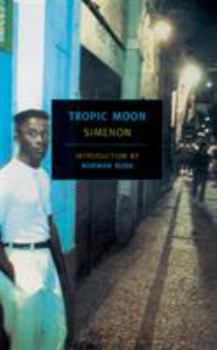
Tropic Moon (New York Review Books Classics)


Select Format
Select Condition 
Book Overview
Newly translated for this edition. A young Frenchman, Joseph Timar, travels to Gabon carrying a letter of introduction from an influential uncle. He wants work experience; he wants to see the world.... This description may be from another edition of this product.
Format:Paperback
Language:English
ISBN:159017111X
ISBN13:9781590171110
Release Date:September 2005
Publisher:NYRB Classics
Length:152 Pages
Weight:0.50 lbs.
Dimensions:8.0" x 0.4" x 5.0"
Customer Reviews
3 ratings
Black
Published by Thriftbooks.com User , 17 years ago
Simenon, the author of over 100 stories featuring Inspector Maigret, did not abandon his skills as a crime writer when writing his serious novels, or "romans durs," of which TROPIC MOON (1933) is one of the first. There is the same laconic straightforward style, the same ability to capture the atmosphere of a setting in a few sentences, and the same interest in those dark areas that lie outside the law. There is a murder here, quite early on in the book, but Simenon's focus is not on who committed it -- that becomes clear well before the end -- but on the psychological nightmare that swirls around it. As the word "dur" (hard) might indicate, this is a hard-boiled novel with a vengeance. Simenon here is the literary cousin of writers of noir fiction such as Dashiell Hammett and (a little later) Raymond Chandler, but his blackness goes beyond being a mere setting for the book; it becomes its principal subject. The setting is Gabon, a former French colony in West Africa. Joseph Timar, a young man from the French provinces, arrives to take up a job with a timber company. While attempting to discover whether the job in fact exists, he stays at a small hotel in Libreville, the capital, where he falls into bed with the hotelier's wife, Adèle. When her husband dies of bilharzia, Joseph enters into a relationship with Adèle that is held together as much by lust and implicit blackmail as by any business agreement, and journeys with her upriver to a timber concession in the interior. That trajectory will be reversed in the last third of the book, bringing them both back to Libreville for the harrowing climax, and sending Timar home to France a shattered victim of his former innocence. The parallels with Conrad's HEART OF DARKNESS are surely deliberate. Both books are set in African colonies; both feature young protagonists who enter the country full of hope and leave in disarray; even the journey upriver, with its stop at a native settlement along the way, makes one think of the earlier novel. But there is no mad Kurtz at the end; the horror that Joseph Timar finds lies inside himself, his companion, and by implication in all the white colonists. For Simenon is as strong as Conrad before him in denouncing colonialism. The governor, police chief, and other white officials whom Joseph visits in Libreville treat him graciously on account of his uncle, a distinguished French politician, yet they have no hesitation in closing ranks against him once their way of life is threatened. But Joseph changes too, most obviously in his rapid descent into alcoholism, but morally as well. At the end of his first week, Joseph accompanies a group of loggers on a sexual debauch exploiting native women, though he holds back from active participation. In a parallel scene later in the palindromic structure of the book, Joseph will not hold back; although his motives are different, the moral result will be the same. Norman Rush, in his unusually strong introduction to the NYRB
Heat of the night
Published by Thriftbooks.com User , 17 years ago
Reading an early Simenon mystery today is as much entertainment as it is a trip into the past. This in especially true for Tropic Moon ("Coup de lune"), originally published in 1933, one of three novels set in Africa. It was also an early example of Simenon's "romans durs" - psychological dramas rather than a Maigret-type detective story that Simenon has been famous for. Having traveled and worked in several countries in Africa for much of 1932, Simenon's personal exposure to the harsh realities of French colonialism are, without doubt, manifest in this brief, intense, yet remarkable and very readable book. The title of the novel hints at the story's intricacy. A term made up in analogy to "coup de soleil" (sunstroke), "coup de lune" suggests "moon stroke", inviting a comparison between the two in terms of the debilitating intensity on those exposed to it. The "victim" here is Joseph Timar, twenty-three years old, arriving in Gabon (then part of French Equatorial Africa) for a vacation - of sorts - from his bourgeois life in France. He is to manage his uncle's timber business set upcountry from the capital Libreville. But things don't turn out as planned. With a few sentences in the opening paragraphs of the novel, Simenon insinuates that Timar's stay will be anything but a vacation. While there is nothing tangible to justify the young man's apprehension - other than being alone in Africa for the first time - an atmosphere of anxiety and unease is established around the protagonist, as he stumbles innocently on an eerily artificial, yet very real, miserable colonialist community. With transport upriver not ready for some time, Timar becomes increasingly entangled with the group of regular patrons of the "Central", the only hotel in town, and Adele, the seductive wife of its owner. With a few precise strokes, Simenon characterized this utterly bored, crude, and lowly collection of expatriates, whose main relaxation consists of alcohol, card games and the odd orgy with local women. While Africans are primarily seen as part of the backdrop, supplying services of various kinds, Simenon does not shy away from describing in some detail the insulting treatment that the Gabonese suffer by this group of whites. The overwhelming impression that the author expertly conveys is the dreariness, squalor and the desolation of the place. Slowly it dawns on Timar, who for the most part remains a naïve outsider, that the local white officials are no better than his drinking and gambling companions. When Thomas, the hotel's young African "boy" is murdered, the investigation is undertaken listlessly. While suspicions as to the culprit are rife, nobody really wants to act on them. A major element amplifying the growing malaise experienced by Timar, is the sweltering heat of the tropical sun, that is stifling any initiative. This is a recurring theme throughout the novel. Simenon aptly employs it to reveal his hero's mental state as he goes through differen
Dark as the African Continent Itself
Published by Thriftbooks.com User , 20 years ago
The prolific Georges Simenon wrote a number of roman durs, or hard novels, which have more of a noir edge to them than his traditional mysteries. TROPIC MOON is a good introduction to them as we follow young Joseph Timar to Africa. In search of job experience and maybe a bit of adventure, he quickly finds himself in way too deep. He almost immediately sleeps with the hotel owner's wife, the morally ambiguous Adele, and quickly thereafter finds himself in the middle of a murder investigation in which everyone else seems to know what is going on while leaving him in the blank. TROPIC MOON, however, is more than just a crime novel. It is a raw depiction of conflict. After learning, in a rather cold and even humiliating way, that Adele has slept with almost every male character in the book, Timar becomes more and more obsessed with her, especially driven as she appears to be somehow implicated in the murder. Adele walks the tightrope of trying to draw Timar closer personally while seeming to protect him from the dark underbelly of the conspiracy. This drama is set against the larger picture of colonial Africa, in which whites and blacks live in two different realities. It is a world of moral confusion and comes to the foreground as the details of Adele's involvement become more and more focused. The ending, although a bit weak, leaves Timar in the same state of confusion as the African continent on which the action unfolds. TROPIC MOON is a quick and worthwhile read.
Copyright © 2026 Thriftbooks.com Terms of Use
| Privacy Policy | Do Not
Sell/Share My Personal Information | Cookie Policy | Cookie Preferences | Accessibility Statement
ThriftBooks® and the ThriftBooks® logo are registered trademarks of Thrift Books Global, LLC
ThriftBooks® and the ThriftBooks® logo are registered trademarks of Thrift Books Global, LLC
