


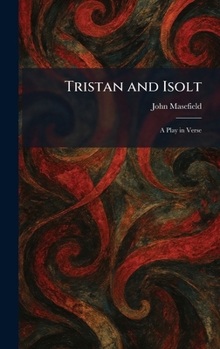
Tristan and Isolt: A Play in Verse

"Tristan and Isolt; A Play in Verse" is a poetic reimagining of one of the most enduring tragedies in Western literature. Written by John Masefield, this work brings the ancient Celtic legend to life through rhythmic and evocative verse, capturing the forbidden passion and inevitable doom of the titular lovers. The play follows the knight Tristan, sent to fetch the Irish princess Isolt for his uncle, King Marc of Cornwall, only for the pair to consume a love potion that binds their fates together in a cycle of longing and betrayal.
Masefield's interpretation emphasizes the lyrical beauty and dramatic tension inherent in the Arthurian cycle. By presenting the narrative as a play in verse, the author highlights the emotional depth of the characters and the stark conflict between personal desire and feudal duty. "Tristan and Isolt; A Play in Verse" stands as a significant contribution to early 20th-century dramatic poetry, offering a sophisticated and atmospheric exploration of a timeless myth. Readers and scholars of Arthurian lore and classical drama will find this rendition a compelling look at the power of fate and the complexities of the human heart.
This work has been selected by scholars as being culturally important, and is part of the knowledge base of civilization as we know it. This work was reproduced from the original artifact, and remains as true to the original work as possible. Therefore, you may see the original copyright references, library stamps (as most of these works have been housed in our most important libraries around the world), and other notations in the work.
This work is in the public domain in the United States of America, and possibly other nations. Within the United States, you may freely copy and distribute this work, as no entity (individual or corporate) has a copyright on the body of the work.
As a reproduction of a historical artifact, this work may contain missing or blurred pages, poor pictures, errant marks, etc. Scholars believe, and we concur, that this work is important enough to be preserved, reproduced, and made generally available to the public. We appreciate your support of the preservation process, and thank you for being an important part of keeping this knowledge alive and relevant.
Related Subjects
DramaCustomer Reviews
ThriftBooks ® and the ThriftBooks ® logo are registered trademarks of Thrift Books Global, LLC
