


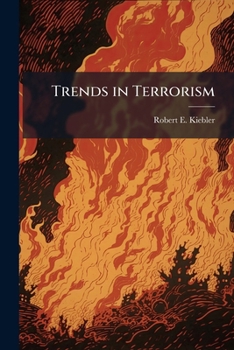
Trends in Terrorism: The Intersection of Motivation, Information Technology, and Weapons of Mass Destruction

The nature of terrorism has changed fundamentally in recent years, with religious extremism and a propensity for violence emerging as dominant characteristics. Terrorist organizations have become technologically sophisticated and dominated by fundamentalist ideologies that promote increasingly violent acts. The rise of Information Technology (IT), coupled with religious fundamentalism, has produced more effective, networked terrorist organizations. IT facilitates the globalization of terror and promotes the transformation of hierarchical organizations to more networked, leaderless groups that are better able to operate effectively in a global environment. The proliferation of information and equipment related to Weapons of Mass Destruction (WMD) creates the potential for a catastrophic event, and terrorist organizations are actively seeking such capabilities to further their interests. This paper analyzes current trends in terrorist motivation and organization, their efforts to acquire WMD capabilities, and makes recommendations for targeting those groups with a propensity for acquiring and employing such weapons. To better combat such emerging organizations, the US government must adopt an actor-based approach that utilizes both open-source information and a clandestine effort to determine network relationships and information flows. To effectively counter a networked organization, US agencies must themselves become networked, and this paper recommends the use of IT to target and track the efforts of terrorist organizations.
This work has been selected by scholars as being culturally important, and is part of the knowledge base of civilization as we know it. This work was reproduced from the original artifact, and remains as true to the original work as possible. Therefore, you will see the original copyright references, library stamps (as most of these works have been housed in our most important libraries around the world), and other notations in the work.
This work is in the public domain in the United States of America, and possibly other nations. Within the United States, you may freely copy and distribute this work, as no entity (individual or corporate) has a copyright on the body of the work.
As a reproduction of a historical artifact, this work may contain missing or blurred pages, poor pictures, errant marks, etc. Scholars believe, and we concur, that this work is important enough to be preserved, reproduced, and made generally available to the public. We appreciate your support of the preservation process, and thank you for being an important part of keeping this knowledge alive and relevant.
Customer Reviews
ThriftBooks ® and the ThriftBooks ® logo are registered trademarks of Thrift Books Global, LLC
