


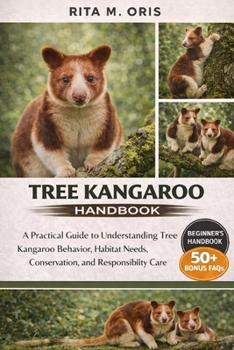
Tree Kangaroo Handbook: A Practical Guide to Understanding Tree Kangaroo Behavior, Habitat Needs, Conservation, and Responsible Care
No Customer Reviews

Introduction to Tree Kangaroos
Tree kangaroos are among the most extraordinary examples of how life can adapt to challenging environments in unexpected ways. At first glance, the idea of a kangaroo living in trees seems almost contradictory. Kangaroos are typically imagined bounding across open plains, using powerful hind legs to cover vast distances on the ground. Tree kangaroos overturn that familiar image entirely. They are kangaroos that have traded speed on land for balance in the canopy, evolving into skilled climbers that move deliberately through branches high above the forest floor. Their existence reshapes how people understand marsupials, forests, and the creative force of evolution itself.
Tree kangaroos belong to a unique branch of the kangaroo family that has adapted to life in dense tropical and subtropical forests. Instead of wide grasslands, their world is made up of towering trees, tangled vines, mossy branches, and steep mountain slopes. These animals live primarily in the rainforests of New Guinea and parts of northeastern Australia, regions known for their incredible biodiversity and complex ecosystems. In these environments, survival depends less on speed and more on agility, spatial awareness, and the ability to navigate vertical space. Tree kangaroos have evolved precisely for this challenge.
What makes tree kangaroos especially fascinating is that they are not primitive or transitional animals, but highly specialized ones. Their ancestors were ground-dwelling kangaroos similar to those seen today. Over long periods of time, certain populations gradually shifted toward forested habitats, where food was abundant in the canopy and competition on the forest floor was intense. As generations passed, natural selection favored individuals that could climb better, balance more effectively, and move safely among branches. The result is an animal that still unmistakably resembles a kangaroo, yet behaves in ways that feel more reminiscent of arboreal mammals such as primates or tree-dwelling bears.
Physically, tree kangaroos immediately appear different once you know what to look for. Their bodies are stockier and more compact than those of ground kangaroos. Their tails are long, thick, and muscular, acting as counterbalances when climbing or descending trees. Their limbs are adapted for gripping rather than bounding, with stronger forearms and more flexible joints that allow them to pull themselves upward and stabilize on uneven surfaces. Even their feet reflect this lifestyle shift, as they are broader and better suited to grasping branches than to pushing off flat ground.
Movement in tree kangaroos is slow and deliberate, especially when compared to their terrestrial relatives. This is not a weakness but a survival strategy. In the canopy, careful placement of each limb reduces the risk of falls and helps them remain undetected by predators. They are capable of impressive feats of balance and strength, including descending trees headfirst, leaping between branches, and even dropping from considerable heights with controlled landings. These movements demonstrate a refined understanding of their environment, shaped by both instinct and experience.
Tree kangaroos are primarily solitary animals, and much of their life unfolds quietly, hidden among leaves and branches. They are not often seen, even in areas where they are known to exist. This elusive nature has contributed to their mystique and, unfortunately, to how little many people know about them. Despite their size, which can rival that of medium to large dogs, they blend seamlessly into the forest through muted coloration and stillness.
Tree kangaroos are among the most extraordinary examples of how life can adapt to challenging environments in unexpected ways. At first glance, the idea of a kangaroo living in trees seems almost contradictory. Kangaroos are typically imagined bounding across open plains, using powerful hind legs to cover vast distances on the ground. Tree kangaroos overturn that familiar image entirely. They are kangaroos that have traded speed on land for balance in the canopy, evolving into skilled climbers that move deliberately through branches high above the forest floor. Their existence reshapes how people understand marsupials, forests, and the creative force of evolution itself.
Tree kangaroos belong to a unique branch of the kangaroo family that has adapted to life in dense tropical and subtropical forests. Instead of wide grasslands, their world is made up of towering trees, tangled vines, mossy branches, and steep mountain slopes. These animals live primarily in the rainforests of New Guinea and parts of northeastern Australia, regions known for their incredible biodiversity and complex ecosystems. In these environments, survival depends less on speed and more on agility, spatial awareness, and the ability to navigate vertical space. Tree kangaroos have evolved precisely for this challenge.
What makes tree kangaroos especially fascinating is that they are not primitive or transitional animals, but highly specialized ones. Their ancestors were ground-dwelling kangaroos similar to those seen today. Over long periods of time, certain populations gradually shifted toward forested habitats, where food was abundant in the canopy and competition on the forest floor was intense. As generations passed, natural selection favored individuals that could climb better, balance more effectively, and move safely among branches. The result is an animal that still unmistakably resembles a kangaroo, yet behaves in ways that feel more reminiscent of arboreal mammals such as primates or tree-dwelling bears.
Physically, tree kangaroos immediately appear different once you know what to look for. Their bodies are stockier and more compact than those of ground kangaroos. Their tails are long, thick, and muscular, acting as counterbalances when climbing or descending trees. Their limbs are adapted for gripping rather than bounding, with stronger forearms and more flexible joints that allow them to pull themselves upward and stabilize on uneven surfaces. Even their feet reflect this lifestyle shift, as they are broader and better suited to grasping branches than to pushing off flat ground.
Movement in tree kangaroos is slow and deliberate, especially when compared to their terrestrial relatives. This is not a weakness but a survival strategy. In the canopy, careful placement of each limb reduces the risk of falls and helps them remain undetected by predators. They are capable of impressive feats of balance and strength, including descending trees headfirst, leaping between branches, and even dropping from considerable heights with controlled landings. These movements demonstrate a refined understanding of their environment, shaped by both instinct and experience.
Tree kangaroos are primarily solitary animals, and much of their life unfolds quietly, hidden among leaves and branches. They are not often seen, even in areas where they are known to exist. This elusive nature has contributed to their mystique and, unfortunately, to how little many people know about them. Despite their size, which can rival that of medium to large dogs, they blend seamlessly into the forest through muted coloration and stillness.
Format:Paperback
Language:English
ISBN:B0GJQVVHGG
ISBN13:9798245313160
Release Date:January 2026
Publisher:Independently Published
Length:114 Pages
Weight:0.36 lbs.
Dimensions:0.2" x 6.0" x 9.0"
Customer Reviews
0 rating
Copyright © 2026 Thriftbooks.com Terms of Use
| Privacy Policy | Do Not
Sell/Share My Personal Information | Cookie Policy | Cookie Preferences | Accessibility Statement
ThriftBooks® and the ThriftBooks® logo are registered trademarks of Thrift Books Global, LLC
ThriftBooks® and the ThriftBooks® logo are registered trademarks of Thrift Books Global, LLC
