


All Formats & Editions
The Art of Rhetoric
For all men are persuaded by considerations of where their interest lies... Aristotle's Art of Rhetoric is the earliest systematic treatment of the subject, and it remains among the most incisive works on rhetoric that we possess. In it, we are asked:...
The Art of Rhetoric
Hugely influential upon Western culture, this fascinating consideration of the force of persuasion is a compelling guide to the principles behind oratorical skill. With the emergence of democracy in the city-state of Athens in the years around 460 BC, public speaking...
Aristotle's Art of Rhetoric
For more than two thousand years. Aristotle's "Art of Rhetoric" has shaped thought on the theory and practice of rhetoric, the art of persuasive speech. In three sections, Aristotle discusses what rhetoric is, as well as the three kinds of rhetoric (deliberative, judicial,...
Rhetoric
One of the seminal works of Western philosophy, Aristotle's Rhetoric vastly influenced all subsequent thought on the subject -- philosophical, political, and literary. Focusing on the use of language as both a vehicle and a tool to shape persuasive argument, Aristotle delineates...

Rhetoric
Rhetoric is one of the most famous works by one of the most famous philosophers in history. Aristotle was one of Ancient Greece's seminal thinkers, a student of Plato's and a tutor of Alexander the Great's. Although Rhetoric seems to be a compilation of notes taken by Aristotle's...
Art of Rhetoric
Persuasion analyzed.
The Art of Rhetoric
HarperCollins is proud to present our range of timeless literary classics. Despite dating from the 4th century BC, The Art of Rhetoric continues to be regarded by many as the single most important work on the art of persuasion. As democracy began emerging in 5th-century...
Rhetoric (The New Hackett Aristotle)
Rhetoric
Aristotle's Rhetoric is an ancient Greek treatise on the art of persuasion, dating from the 4th century BC. In English, its title varies: typically it is titled the Rhetoric, the Art of Rhetoric, or a Treatise on Rhetoric. Like the other works of Aristotle that have survived...
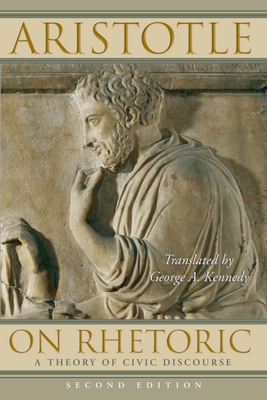
On Rhetoric: A Theory of Civic Discourse
This new edition of George A. Kennedy's highly acclaimed translation and commentary offers the most faithful English version ever published of On Rhetoric. Based on careful study of the Greek text and informed by the best modern scholarship, the second edition has been fully...
Rhetoric
Aristotle's Rhetoric is an ancient Greek treatise on the art of persuasion, dating from the 4th century BC. In Greek, it is titled ΤΕΧΝΗ ΡΗΤΟΡΙΚΗ, in Latin Ars Rhetorica. In English, its title varies: typically...
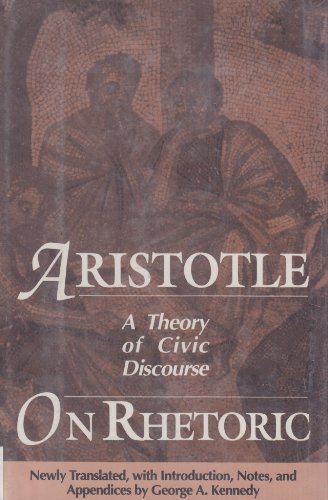
On Rhetoric: A Theory of Civil Discourse
Theories of rhetoric initially emerged in Greece in the fifth century B.C. with the realization that in a democracy all citizens had a right and duty to participate in their own government. Aristotle's Rhetoric was the first, systematic study of civic discourse. But this classic...
Rhetoric
RHETORIC the counterpart of Dialectic. Both alike are concerned with such things as come more or less within the general ken of all men and belong to no definite science. Accordingly all men make use more or less of both; for to a certain extent all men attempt to discuss statements...
Rhetoric
Rhetoric
ARISTOTLE (384 BC - 322 BC), translated by Thomas TAYLOR (1758 - 1835) The Rhetoric was developed by Aristotle during two periods when he was in Athens, the first between 367 to 347 BCE (when he was seconded to Plato in the Academy), and the...
Aristotle's Art of Rhetoric
For more than two thousand years. Aristotle's "Art of Rhetoric" has shaped thought on the theory and practice of rhetoric, the art of persuasive speech. In three sections, Aristotle discusses what rhetoric is, as well as the three kinds of rhetoric (deliberative, judicial,...
On Rhetoric: A Theory of Civic Discourse
Rhetoric in fifty years. Based on careful study of the Greek text and informed by the best modern scholarship, it is the most faithful English version ever published of the book that first defined and organized the study of civic discourse along philosophical lines and still...
![Arte de la retórica, El [Spanish] 9502314735 Book Cover](https://m.media-amazon.com/images/I/31kJ07KHEuL._SL500_.jpg)
Arte de la retórica, El [Spanish]

Rhetoric
The Greek philosopher Aristotle is one of the founding figures in Western philosophy. His writings cover a multitude of subjects from physics, poetry, theater, music, politics, science and gods. His writings are the earliest known use of formal logic which was latter incorporated...
![Aristotle, XXII, Art of Rhetoric [Greek, Ancient (to 1453)] 0674992121 Book Cover](https://i.thriftbooks.com/api/imagehandler/l/546DD764E5E54753D2D835C7F648B3DD2EE50B7F.jpeg)
Aristotle, XXII, Art of Rhetoric [Greek, Ancient (to 1453)]
Aristotle, great Greek philosopher, researcher, reasoner, and writer, born at Stagirus in 384 BCE, was the son of Nicomachus, a physician, and Phaestis. He studied under Plato at Athens and taught there (367-47); subsequently he spent three years at the court of a former pupil,...
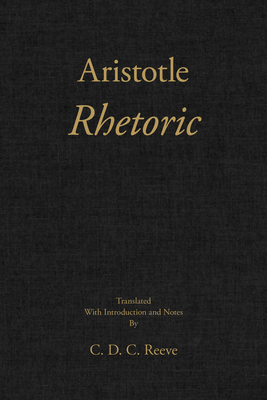
Rhetoric (The New Hackett Aristotle)
This new translation of Aristotle's Rhetoric , noteworthy for its consistency and accuracy, is the latest addition to the New Hackett Aristotle series. Fitting seamlessly with the others in the series, it enables Anglophone readers to read Aristotle's works in a way previously...
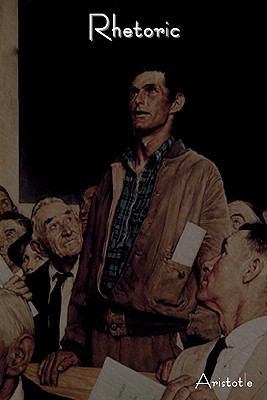
Rhetoric
Aristotle's Rhetoric is an ancient Greek treatise on the art of persuasion, dating from the 4th century BC. In Greek, it is titled ΤΕΧΝΗ ΡΗΤΟΡΙΚΗ, in Latin Ars Rhetorica. In English, its title varies: typically...

Indians: Portrait Of A People

ThriftBooks ® and the ThriftBooks ® logo are registered trademarks of Thrift Books Global, LLC
