


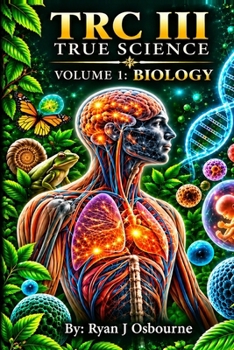
TRC III VOLUME ONE - BIOLOGY: Life - Evolution - Systems From Cells to Conscious Organisms. (The Theory of Recursive Consciousness.)
No Customer Reviews

WHAT IF WE LIVE IN A DREAM? Every night, the human brain accomplishes something extraordinary. It constructs entire worlds populated by people, places, emotions, memories, and experiences that can feel completely real. Yet the body producing those experiences remains asleep. What if this familiar biological ability holds the key to a much larger question about consciousness itself? TRC III: VOLUME I: BIOLOGY introduces readers to the biological foundations of the Theory of Recursive Consciousness, an ambitious speculative framework exploring how living organisms generate subjective experience and why evolution might have favoured the machinery capable of producing it. Beginning with the strange phenomenon of intrusive thoughts and spontaneous imagination, the investigation follows a remarkable evolutionary possibility: organisms capable of imagining events may learn from experiences they never physically encounter. A dangerous situation can be rehearsed without risking injury. A social conflict can be explored from different perspectives. A problem can be reconsidered while the body sleeps. But the investigation does not stop with ordinary dreaming. Drawing upon research into neuroscience, neural networks, memory, sleep, perception, evolutionary adaptation, and social cognition, the book introduces a provocative distinction between the biological system generating an experience and the conscious perspective experiencing it. TRC calls these the Vessel and the Self. From this foundation emerges a more extraordinary possibility: could one biological system generate multiple bounded perspectives within internally constructed realities? Could the experiences of those perspectives influence the larger organism even when their individual memories disappear? Across 33 chapters, Biology examines the machinery of consciousness, the evolutionary costs of complex nervous systems, the relationship between imagination and survival, the construction of subjective identity, and the remarkable ability of biological organisms to model worlds beyond their immediate surroundings. Established scientific findings provide the foundation. The Theory of Recursive Consciousness supplies the speculative questions, carefully distinguishing what neuroscience has demonstrated from what remains hypothetical. This is not a declaration that reality is a dream. It is an invitation to investigate what biology already knows about the extraordinary machinery capable of producing one. The first volume in a nine-book exploration of consciousness, identity, psychology, philosophy, dreaming, and the mysteries of subjective existence. Before asking whether reality itself could be a dream, there is a more fundamental question. How did evolution build the Dreamer?
Format:Paperback
Language:English
ISBN:B0HRDMRQ86
ISBN13:9798167458802
Release Date:November 2026
Publisher:Independently published
Length:230 Pages
Weight:0.63 lbs.
Dimensions:9.0" x 0.6" x 6.0"
Customer Reviews
0 rating
Copyright © 2026 Thriftbooks.com
Terms of Use | Privacy Policy | Do Not Sell/Share My Personal Information | Cookie Notice | Cookie Preferences | Accessibility Statement
ThriftBooks ® and the ThriftBooks ® logo are registered trademarks of Thrift Books Global, LLC
ThriftBooks ® and the ThriftBooks ® logo are registered trademarks of Thrift Books Global, LLC
