


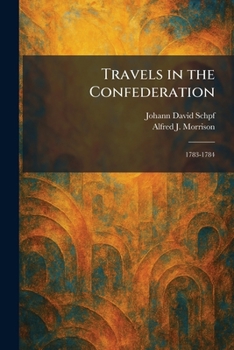
Travels in the Confederation: 1783-1784

"Travels in the Confederation 1783-1784" is a detailed and illuminating account of the newly independent United States during the critical years immediately following the Revolutionary War. Written by Johann David Sch pf, a German physician and naturalist who served as a surgeon to the Hessian troops, this work provides a rare eyewitness perspective on a nation in its infancy. As Sch pf journeys through the states of the Atlantic seaboard-from New Jersey and Pennsylvania down to the Carolinas and Florida-he records meticulous observations on the American landscape, its geology, flora, and the socio-political climate of the Confederation period.
The narrative captures the spirit of a fledgling democracy, offering vivid portraits of the people, customs, and economic conditions of the late eighteenth century. Sch pf's scientific background lends an analytical depth to his descriptions of the natural world, while his keen interest in human affairs provides a valuable record of early American society and its diverse inhabitants. This volume serves as an essential primary source for historians and readers interested in the formative years of the United States, documenting the challenges of a country forging its identity in the wake of conflict. Through Sch pf's eyes, the complexities of the American frontier and emerging urban centers are brought to life with clarity and historical precision.
This work has been selected by scholars as being culturally important, and is part of the knowledge base of civilization as we know it. This work was reproduced from the original artifact, and remains as true to the original work as possible. Therefore, you may see the original copyright references, library stamps (as most of these works have been housed in our most important libraries around the world), and other notations in the work.
This work is in the public domain in the United States of America, and possibly other nations. Within the United States, you may freely copy and distribute this work, as no entity (individual or corporate) has a copyright on the body of the work.
As a reproduction of a historical artifact, this work may contain missing or blurred pages, poor pictures, errant marks, etc. Scholars believe, and we concur, that this work is important enough to be preserved, reproduced, and made generally available to the public. We appreciate your support of the preservation process, and thank you for being an important part of keeping this knowledge alive and relevant.
Customer Reviews
ThriftBooks ® and the ThriftBooks ® logo are registered trademarks of Thrift Books Global, LLC
