


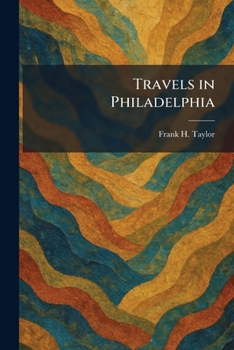
Travels in Philadelphia

"Travels in Philadelphia" is an evocative exploration of one of America's most historic cities, captured through the keen eyes of artist and writer Frank H. Taylor. This work serves as both a travelogue and a historical record, guiding readers through the winding streets, monumental landmarks, and hidden corners of the Quaker City during the early 20th century.
The narrative delves into the rich architectural heritage and the evolving urban landscape of Philadelphia, offering detailed sketches and descriptions that bring the city's past to life. Taylor highlights the significance of Independence Hall, the charm of colonial-era alleys, and the bustling energy of the city's commercial centers. By blending historical anecdotes with contemporary observations, the author provides a comprehensive portrait of a metropolis in transition, honoring its Revolutionary roots while witnessing its modern growth.
For readers interested in urban history, American heritage, and the unique character of Pennsylvania's largest city, "Travels in Philadelphia" remains an essential guide. It captures the spirit of a bygone era, preserving the stories and sights that define Philadelphia's enduring legacy as a cornerstone of the American experience.
This work has been selected by scholars as being culturally important, and is part of the knowledge base of civilization as we know it. This work was reproduced from the original artifact, and remains as true to the original work as possible. Therefore, you may see the original copyright references, library stamps (as most of these works have been housed in our most important libraries around the world), and other notations in the work.
This work is in the public domain in the United States of America, and possibly other nations. Within the United States, you may freely copy and distribute this work, as no entity (individual or corporate) has a copyright on the body of the work.
As a reproduction of a historical artifact, this work may contain missing or blurred pages, poor pictures, errant marks, etc. Scholars believe, and we concur, that this work is important enough to be preserved, reproduced, and made generally available to the public. We appreciate your support of the preservation process, and thank you for being an important part of keeping this knowledge alive and relevant.
Customer Reviews
ThriftBooks ® and the ThriftBooks ® logo are registered trademarks of Thrift Books Global, LLC
