


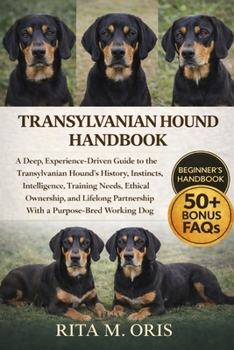
Transylvanian Hound Handbook: A Deep, Experience-Driven Guide to the Transylvanian Hound's History, Instincts, Intelligence, Training Needs, Ethical O
No Customer Reviews

INTRODUCTION
Origins of the Transylvanian Hound
The Transylvanian Hound carries its history in a way you can feel the moment you spend real time around one. Even before anyone tells you where the breed comes from, you sense the purpose in its posture, the steadiness in its gaze, and the quiet confidence that comes from generations of work that demanded stamina, judgment, and courage. This is not a modern invention shaped primarily for looks. It is a working hound formed by landscape, weather, and a hunting culture that needed a dog capable of staying focused for hours, moving through dense forest and steep ground without falling apart physically or mentally, and returning to people with the same reliability it left with. When you start at the beginning, the Transylvanian Hound becomes easier to understand in the present, because its instincts, sensitivities, and strengths make the most sense when you remember what the breed was built to do.
Transylvania, as a region, is not only a place on a map but a set of realities that shaped the animals and people who lived there. For centuries, the Carpathian Basin and the forests and hills of Transylvania created a hard environment for travel and for hunting. Weather could shift quickly, winters could be punishing, and the ground itself demanded strong legs and sure-footed movement. Hunting was not always sport in the modern sense. It was tied to food, protection of livestock, and the responsibilities of households and estates. The kinds of game pursued in these regions-wild boar, deer, and other animals capable of sudden turns, long flights, or violent defense-required dogs that were not simply fast, but durable, sensible, and brave without being reckless. A dog that panicked, quit, or made poor decisions could be lost, injured, or could cause people danger. That pressure, repeated across generations, does something powerful to a breed. It produces an animal that is steady enough to work under stress, alert enough to read the environment, and tough enough to keep going when conditions aren't gentle.
The Transylvanian Hound is historically associated with Hungarian hunting traditions, and the breed's development is often linked to the medieval and early modern periods when noble hunting culture placed high value on specialized dogs. In those times, dogs were not treated as generic tools. People knew the difference between a dog suited for the open plain and a dog suited for mountainous forest. They knew which animals required more grit, which hunts demanded patience, and which demanded the ability to follow scent when the trail was old or broken. Over time, selective breeding-sometimes formal and sometimes simply practical-favored hounds that could track in the forests and hills, communicate with handlers from a distance, and keep pressure on game without losing control. You can see remnants of that history in the breed's overall style. The Transylvanian Hound is not frantic. It is not the type of dog that burns itself out in a burst of energy. It tends to work with a long, steady engine, which is exactly what you would want in a dog expected to travel far and stay useful the entire time.
The breed's story is also shaped by periods of decline and recovery. Many old European working breeds faced challenges as society changed. Wars, shifting borders, changes in land use, and modernization of hunting methods often reduced the demand for traditional hounds. When people no longer hunted the same way, or when vast forests were cut back or reorganized, the kinds of dogs that were once essential became less common. It is easy for a breed with a strong regional identity to become rare when the region's lifestyle changes. In the case of the Transylvanian Hound, the breed survived because enough people recognized its value and worked to preserve it.
Origins of the Transylvanian Hound
The Transylvanian Hound carries its history in a way you can feel the moment you spend real time around one. Even before anyone tells you where the breed comes from, you sense the purpose in its posture, the steadiness in its gaze, and the quiet confidence that comes from generations of work that demanded stamina, judgment, and courage. This is not a modern invention shaped primarily for looks. It is a working hound formed by landscape, weather, and a hunting culture that needed a dog capable of staying focused for hours, moving through dense forest and steep ground without falling apart physically or mentally, and returning to people with the same reliability it left with. When you start at the beginning, the Transylvanian Hound becomes easier to understand in the present, because its instincts, sensitivities, and strengths make the most sense when you remember what the breed was built to do.
Transylvania, as a region, is not only a place on a map but a set of realities that shaped the animals and people who lived there. For centuries, the Carpathian Basin and the forests and hills of Transylvania created a hard environment for travel and for hunting. Weather could shift quickly, winters could be punishing, and the ground itself demanded strong legs and sure-footed movement. Hunting was not always sport in the modern sense. It was tied to food, protection of livestock, and the responsibilities of households and estates. The kinds of game pursued in these regions-wild boar, deer, and other animals capable of sudden turns, long flights, or violent defense-required dogs that were not simply fast, but durable, sensible, and brave without being reckless. A dog that panicked, quit, or made poor decisions could be lost, injured, or could cause people danger. That pressure, repeated across generations, does something powerful to a breed. It produces an animal that is steady enough to work under stress, alert enough to read the environment, and tough enough to keep going when conditions aren't gentle.
The Transylvanian Hound is historically associated with Hungarian hunting traditions, and the breed's development is often linked to the medieval and early modern periods when noble hunting culture placed high value on specialized dogs. In those times, dogs were not treated as generic tools. People knew the difference between a dog suited for the open plain and a dog suited for mountainous forest. They knew which animals required more grit, which hunts demanded patience, and which demanded the ability to follow scent when the trail was old or broken. Over time, selective breeding-sometimes formal and sometimes simply practical-favored hounds that could track in the forests and hills, communicate with handlers from a distance, and keep pressure on game without losing control. You can see remnants of that history in the breed's overall style. The Transylvanian Hound is not frantic. It is not the type of dog that burns itself out in a burst of energy. It tends to work with a long, steady engine, which is exactly what you would want in a dog expected to travel far and stay useful the entire time.
The breed's story is also shaped by periods of decline and recovery. Many old European working breeds faced challenges as society changed. Wars, shifting borders, changes in land use, and modernization of hunting methods often reduced the demand for traditional hounds. When people no longer hunted the same way, or when vast forests were cut back or reorganized, the kinds of dogs that were once essential became less common. It is easy for a breed with a strong regional identity to become rare when the region's lifestyle changes. In the case of the Transylvanian Hound, the breed survived because enough people recognized its value and worked to preserve it.
Format:Paperback
Language:English
ISBN:B0GJQVPH2N
ISBN13:9798245310671
Release Date:January 2026
Publisher:Independently Published
Length:168 Pages
Weight:0.51 lbs.
Dimensions:0.4" x 6.0" x 9.0"
Customer Reviews
0 rating
Copyright © 2026 Thriftbooks.com
Terms of Use | Privacy Policy | Do Not Sell/Share My Personal Information | Cookie Policy | Cookie Preferences | Accessibility Statement
ThriftBooks ® and the ThriftBooks ® logo are registered trademarks of Thrift Books Global, LLC
ThriftBooks ® and the ThriftBooks ® logo are registered trademarks of Thrift Books Global, LLC
