


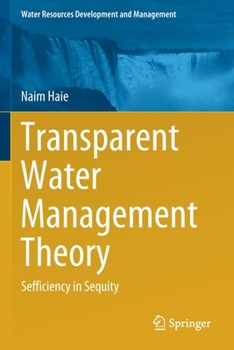
Transparent Water Management Theory: Sefficiency in Sequity
No Customer Reviews

Select Format
Select Condition 
Book Overview
1. Introduction
1.1. Water Security, Governance or Management
1.2. Bounded Rationality
2. Terminology
2.1. Water Use System (WUS)
2.2. Pillars: Quantity, Quality, Benefits
2.3. Water Use and Reuse
2.4. Binary Opposites in Water
2.5. Water Loss of flows and systems
2.5.1. Unrecoverables
3. Theory
3.1. Five FIWs (Foundational Ideas about a WUS)
3.2. Learning with Stakeholders
3.3. Smart Water Use Systems
4. Sefficiency (Sustainable efficiency)
4.1. Proof of Sefficiency Indicators
4.2. Levels of Management
4.3. Weights
4.3.1. Quality attribute
4.3.2. Beneficial attribute
4.3.3. Usefulness Criterion
4.4. Trade-offs
4.4.1. Jevons Paradox
4.4.2. Differentials
4.4.3. Graphs
4.5. Alternatives
4.5.1. Classical Efficiency
4.5.2. Water Productivity
4.5.3. Effective Efficiency
4.5.4. Resiliency
5. Sequity (Sustainable equity)
5.1. Segments
5.2. Equity Revisited
5.3. Targets
5.4. Policies
5.4.1. Type I
5.4.2. Type II
5.4.3. Type III
5.4.4. Type IV
5.5. Reality Check
5.6. Phases in decision-making
6. Applications
6.1. An Illusion
6.2. Urban 1
6.3. Urban 2
6.4. Farm
6.5. Water, Energy, Food
7. Annexes
7.1. Symbols
7.2. Sefficiency template
7.3. Equivalency
7.4. Evapotranspiration
7.4.1. Temperature
7.4.2. Penman-Monteith
7.4.3. Hargreaves-Samani
References
1.1. Water Security, Governance or Management
1.2. Bounded Rationality
2. Terminology
2.1. Water Use System (WUS)
2.2. Pillars: Quantity, Quality, Benefits
2.3. Water Use and Reuse
2.4. Binary Opposites in Water
2.5. Water Loss of flows and systems
2.5.1. Unrecoverables
3. Theory
3.1. Five FIWs (Foundational Ideas about a WUS)
3.2. Learning with Stakeholders
3.3. Smart Water Use Systems
4. Sefficiency (Sustainable efficiency)
4.1. Proof of Sefficiency Indicators
4.2. Levels of Management
4.3. Weights
4.3.1. Quality attribute
4.3.2. Beneficial attribute
4.3.3. Usefulness Criterion
4.4. Trade-offs
4.4.1. Jevons Paradox
4.4.2. Differentials
4.4.3. Graphs
4.5. Alternatives
4.5.1. Classical Efficiency
4.5.2. Water Productivity
4.5.3. Effective Efficiency
4.5.4. Resiliency
5. Sequity (Sustainable equity)
5.1. Segments
5.2. Equity Revisited
5.3. Targets
5.4. Policies
5.4.1. Type I
5.4.2. Type II
5.4.3. Type III
5.4.4. Type IV
5.5. Reality Check
5.6. Phases in decision-making
6. Applications
6.1. An Illusion
6.2. Urban 1
6.3. Urban 2
6.4. Farm
6.5. Water, Energy, Food
7. Annexes
7.1. Symbols
7.2. Sefficiency template
7.3. Equivalency
7.4. Evapotranspiration
7.4.1. Temperature
7.4.2. Penman-Monteith
7.4.3. Hargreaves-Samani
References
Format:Paperback
Language:English
ISBN:9811562865
ISBN13:9789811562860
Release Date:June 2021
Publisher:Springer
Length:119 Pages
Weight:0.44 lbs.
Dimensions:0.3" x 6.1" x 9.2"
Customer Reviews
0 rating
Copyright © 2025 Thriftbooks.com
Terms of Use | Privacy Policy | Do Not Sell/Share My Personal Information | Cookie Policy | Cookie Preferences | Accessibility Statement
ThriftBooks ® and the ThriftBooks ® logo are registered trademarks of Thrift Books Global, LLC
ThriftBooks ® and the ThriftBooks ® logo are registered trademarks of Thrift Books Global, LLC
