


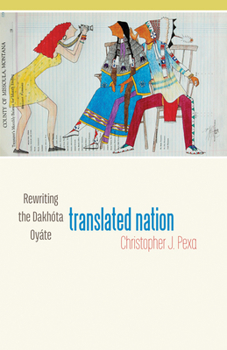
Translated Nation: Rewriting the Dakhóta Oyáte

Select Format
Select Condition 
Book Overview
How authors rendered Dakh?ta philosophy by literary means to encode ethical and political connectedness and sovereign life within a settler surveillance state
Translated Nation examines literary works and oral histories by Dakh?ta intellectuals from the aftermath of the 1862 U.S.-Dakota War to the present day, highlighting creative Dakh?ta responses to violences of the settler colonial state. Christopher Pexa argues that the assimilation era of federal U.S. law and policy was far from an idle one for the Dakh?ta people, but rather involved remaking the Oy?te (the Oč?ti Sak?wiŋ Oy?te or People of the Seven Council Fires) through the encrypting of Dakh?ta political and relational norms in plain view of settler audiences.
From Nicholas Black Elk to Charles Alexander Eastman to Ella Cara Deloria, Pexa analyzes well-known writers from a tribally centered perspective that highlights their contributions to Dakh?ta/Lakh?ta philosophy and politics. He explores how these authors, as well as oral histories from the Spirit Lake Dakh?ta Nation, invoke thi?spaye (extended family or kinship) ethics to critique U.S. legal translations of Dakh?ta relations and politics into liberal molds of heteronormativity, individualism, property, and citizenship. He examines how Dakh?ta intellectuals remained part of their social frameworks even while negotiating the possibilities and violence of settler colonial framings, ideologies, and social forms.
Bringing together oral and written as well as past and present literatures, Translated Nation expands our sense of literary archives and political agency and demonstrates how Dakh?ta peoplehood not only emerges over time but in everyday places, activities, and stories. It provides a distinctive view of the hidden vibrancy of a historical period that is often tied only to Indigenous survival.
Customer Reviews
ThriftBooks® and the ThriftBooks® logo are registered trademarks of Thrift Books Global, LLC
