


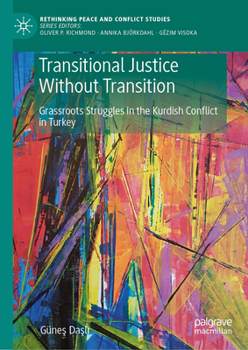
Transitional Justice Without Transition: Grassroots Struggles in the Kurdish Conflict in Turkey
No Customer Reviews

How can transitional justice take root where there is no transition? This book confronts this central tension by examining the Kurdish conflict in Turkey -- a context where the absence of a transitional moment has not prevented grassroots actors from building a justice process of their own. Drawing on extensive fieldwork, it maps the transitional justice ecosystem in Turkey: the actors who sustain it, the demands they articulate, the strategies they pursue, and the networks they forge under conditions of ongoing conflict and authoritarian regime.
Rather than treating transitional justice as something imposed from above, the book situates civil society as its driving force, contributing to a broader rethinking of the field. Its conceptual contribution lies in the application of relationality as an analytical lens, drawing on feminist moral philosophy and relational sociology to unpack complex victim agency. The book offers empirical and theoretical tools for scholars and practitioners studying justice struggles in contexts that resist easy categorisation.
Format:Hardcover
Language:English
ISBN:3032183375
ISBN13:9783032183378
Release Date:May 2026
Publisher:Palgrave MacMillan
Length:188 Pages
Weight:0.84 lbs.
Dimensions:0.6" x 6.2" x 8.3"
Customer Reviews
0 rating
Copyright © 2026 Thriftbooks.com
Terms of Use | Privacy Policy | Do Not Sell/Share My Personal Information | Cookie Policy | Cookie Preferences | Accessibility Statement
ThriftBooks ® and the ThriftBooks ® logo are registered trademarks of Thrift Books Global, LLC
ThriftBooks ® and the ThriftBooks ® logo are registered trademarks of Thrift Books Global, LLC
