


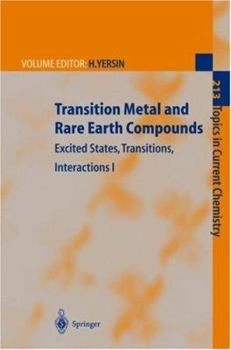
Transition Metal and Rare Earth Compounds: Excited States, Transitions, Interactions I
No Customer Reviews

Select Format
Select Condition 
Book Overview
For a long time, the properties of transition metal and rare earth compounds have fascinated chemists and physicists from a scientific view-point, and more recently also their enormous potential as new materials has been explored. Applications in different fields have already been realized or are under c- rent investigation, for example, new laser materials, IR to visible upconversion systems, compounds for photolithographic processes, systems involving pho- redox processes for solar energy conversion, new photovoltaic devices, chemical sensors, biosensors, electroluminescent devices (OLEDs) for flat panel display systems, supramolecular devices with wide-range definable photophysical properties, materials for energy harvesting, optical information and storage systems, etc. Metal complexes are also highly important in biology and me- cine. Most of the applications mentioned are directly related to the properties of the electronic ground state and the lower-lying excited states. Metal complexes with organic ligands or organometallic compounds exhibit outstanding features as compared to purely organic molecules. For instance, metal compounds can often be prepared and applied in different oxidation states. Furthermore, various types of low-lying electronic excitations can be induced by a suitable choice of ligands, for example, such as metal-centered transitions (MC, e. g. d-d* tran- tion), ligand-centered (LC, e. g. n-n*), metal-to-ligand-charge transfer (MLCT, e. g. d-7r*), intra-ligand-charge-transfer (ILCT) transitions, etc. In particular, the orbitals involved in the resulting lowest excited states determine the photoph- ical and photochemical properties and thus the specific use of the compound.
Format:Hardcover
Language:English
ISBN:3540679863
ISBN13:9783540679868
Release Date:December 2000
Publisher:Springer
Length:186 Pages
Weight:1.02 lbs.
Dimensions:0.5" x 6.1" x 9.2"
Related Subjects
Medical Medical Books Science Science & Math Science & Scientists Science & TechnologyCustomer Reviews
0 rating
Copyright © 2026 Thriftbooks.com Terms of Use
| Privacy Policy | Do Not
Sell/Share My Personal Information | Cookie Policy | Cookie Preferences | Accessibility Statement
ThriftBooks® and the ThriftBooks® logo are registered trademarks of Thrift Books Global, LLC
ThriftBooks® and the ThriftBooks® logo are registered trademarks of Thrift Books Global, LLC
