


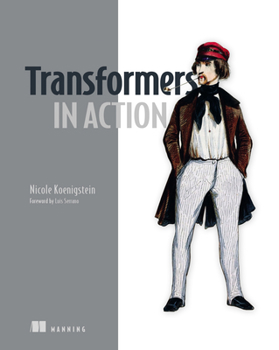
Transformers in Action
No Customer Reviews

Understand the architecture that underpins today's most powerful AI models. Transformers are the superpower behind large language models (LLMs) like ChatGPT, Gemini, and Claude. Transformers in Action gives you the insights, practical techniques, and extensive code samples you need to adapt pretrained transformer models to new and exciting tasks. Inside Transformers in Action you'll learn: How transformers and LLMs workModeling families and architecture variantsEfficient and specialized large language modelsAdapt HuggingFace models to new tasksAutomate hyperparameter search with Ray Tune and OptunaOptimize LLM model performanceAdvanced prompting and zero/few-shot learningText generation with reinforcement learningResponsible LLMsTransformers in Action takes you from the origins of transformers all the way to fine-tuning an LLM for your own projects. Author Nicole Koenigstein demonstrates the vital mathematical and theoretical background of the transformer architecture practically through executable Jupyter notebooks. You'll discover advice on prompt engineering, as well as proven-and-tested methods for optimizing and tuning large language models. Plus, you'll find unique coverage of AI ethics, specialized smaller models, and the decoder encoder architecture. Foreword by Luis Serrano. About the technology Transformers are the beating heart of large language models (LLMs) and other generative AI tools. These powerful neural networks use a mechanism called self-attention, which enables them to dynamically evaluate the relevance of each input element in context. Transformer-based models can understand and generate natural language, translate between languages, summarize text, and even write code--all with impressive fluency and coherence. About the book Transformers in Action introduces you to transformers and large language models with careful attention to their design and mathematical underpinnings. You'll learn why architecture matters for speed, scale, and retrieval as you explore applications including RAG and multi-modal models. Along the way, you'll discover how to optimize training and performance using advanced sampling and decoding techniques, use reinforcement learning to align models with human preferences, and more. The hands-on Jupyter notebooks and real-world examples ensure you'll see transformers in action as you go. What's insideOptimizing LLM model performanceAdapting HuggingFace models to new tasksHow transformers and LLMs work under the hoodMitigating bias and responsible ethics in LLMsAbout the reader For data scientists and machine learning engineers. About the author Nicole Koenigstein is the Co-Founder and Chief AI Officer at the fintech company Quantmate. Table of Contents Part 1
1 The need for transformers
2 A deeper look into transformers
Part 2
3 Model families and architecture variants
4 Text generation strategies and prompting techniques
5 Preference alignment and retrieval-augmented generation
Part 3
6 Multimodal models
7 Efficient and specialized small language models
8 Training and evaluating large language models
9 Optimizing and scaling large language models
10 Ethical and responsible large language models
Format:Paperback
Language:English
ISBN:1633437884
ISBN13:9781633437883
Release Date:November 2025
Publisher:Manning Publications
Length:256 Pages
Weight:0.70 lbs.
Dimensions:0.9" x 7.3" x 9.2"
Customer Reviews
0 rating
Copyright © 2026 Thriftbooks.com
Terms of Use | Privacy Policy | Do Not Sell/Share My Personal Information | Cookie Notice | Cookie Preferences | Accessibility Statement
ThriftBooks ® and the ThriftBooks ® logo are registered trademarks of Thrift Books Global, LLC
ThriftBooks ® and the ThriftBooks ® logo are registered trademarks of Thrift Books Global, LLC
