


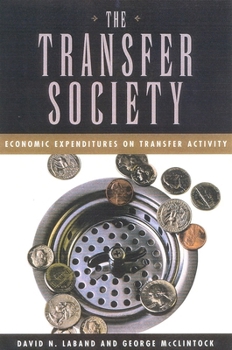
The Transfer Society: Economic Expenditures on Transfer Activity


This book makes a significant contribution to both political science and economics in terms a layman can understand.
Format:Paperback
Language:English
ISBN:1930865112
ISBN13:9781930865112
Release Date:October 2001
Publisher:Cato Institute
Length:100 Pages
Weight:0.40 lbs.
Dimensions:9.0" x 0.3" x 5.9"
Customer Reviews
3 ratings
In depth study
Published by Thriftbooks.com User , 22 years ago
This book is not all that hard to understand. In simple terms, Laband and McClintock tell us that we waste a lot of money trying to avoid someone else wasting our money. It's not this fact that puts the reader so off guard. The fact that our society spends about four hundred billion dollars trying to influence two trillion dollars in government expenditures (about twenty percent of the total) shows what an inefficient mess our economy has become. This fact of wasted wealth should shock the reader. I couldn't believe it at first. The amount of research used is impressive and definitive. Though Laband and McClintock don't offer any serious solutions to the drain on the economy, this volume helps shape the continuing debate about wealth transfer.
Coercion Costs!
Published by Thriftbooks.com User , 22 years ago
When the government robs Peter in order to pay Paul, they have to pay for the entire process of robbing: constructing laws, buying the guns, hiring more bureaucrats, etc. In other words, when government spends funds to redistribute income, they divert resources that could be used on more productive activities."The Transfer Society" is a slim but marvelous study on how much the government spends each year on enforcing the coercive transfer of money from one party to another. You may think that these forced transfers do not cost very much money -- and if one takes each transfer at a time, he may be right. But taken as a whole, multiplied by the government's long reaching tenacles, they estimate that the government spends $400B redistributing. But if that was not enough, Laband and McClintock go on to demosntrate that this projected $400B is in reality an understatement; they cannot estimate the preemptive measures taken by individuals to protect their property from the government. For example, if the government used eminent domain to seize somebody's land, L & M's model would not account for the costs of one hiring a lawyer to protect himself from coercive government. Forced transfers, thus, waste a staggering amount of money that would be better used in productive activity.This book is a timely economic complement to the moral argument against forced expropriation. The magnitude of the problem is exposed so convincingly that it should become a focus of attention for quite some time.
A refreshingly different perspective on new wealth
Published by Thriftbooks.com User , 24 years ago
How much time, money and resources have been allotted to influence how wealth is distributed in this country? Over $2,000 year for every individual, according to this title. The figure doesn't represent the amount transferred, but the amount spent on influencing transfers. Transfer Society provides a refreshingly different perspective on new wealth and the process of distributing wealth within the government and private sectors. Intriguing and different.
Copyright © 2026 Thriftbooks.com Terms of Use
| Privacy Policy | Do Not
Sell/Share My Personal Information | Cookie Policy | Cookie Preferences | Accessibility Statement
ThriftBooks® and the ThriftBooks® logo are registered trademarks of Thrift Books Global, LLC
ThriftBooks® and the ThriftBooks® logo are registered trademarks of Thrift Books Global, LLC
