


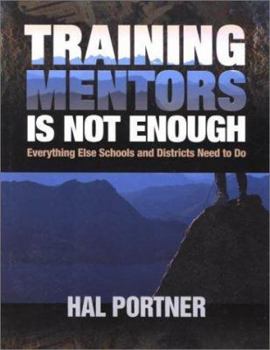
Training Mentors Is Not Enough: Everything Else Schools and Districts Need to Do

Select Format
Select Condition 
Book Overview
This how-to guide and practical workbook will help planners and participants develop an exemplary mentoring program or upgrade an existing one.
Format:Paperback
Language:English
ISBN:0761977384
ISBN13:9780761977384
Release Date:April 2001
Publisher:Corwin Publishers
Length:128 Pages
Weight:1.55 lbs.
Dimensions:0.3" x 8.9" x 10.5"
Customer Reviews
2 ratings
What some readers are saying
Published by Thriftbooks.com User , 24 years ago
"Portner's work provides all educators with a look at both the philosophical side of mentoring new teachers and the very practical side of operating an effective mentoring program. As the teacher shortage grows more pronounced, this book can be a basic blueprint for success in addressing recruitment, induction, and retention of the best possible teachers in any district, large or small, urban or suburban or rural." Carl E. O'Connell, Mentor Program Coordinator Rochester City School District and Rochester Teachers Association, NY "This book is packed with practical suggestions and detailed hints on how a program can be set up and woven into the fabric of a school in a systemic way. Portner captures the ups and downs of mentoring relationships and proposes effective ways to keep mentoring programs energized." Charles E. Gobron, Teacher Chair, Professional Development Council, Massachusetts Teachers Association A roadmap for highly effective mentoring programs! Educator, program consultant, and author Hal Portner is an authority on how to craft a mentoring program that validates, supports, and celebrates every aspect of the mentor-mentee relationship.
Author's comments
Published by Thriftbooks.com User , 24 years ago
I have written this book for educational leaders who want to develop an exemplary mentoring program or upgrade an existing one. It is for everyone committed to being part of a program that validates, supports and celebrates every aspect of the mentor-mentee relationship. It is intended as a) a how-to guide and workbook for planners and doers; b) a practical reference and management tool for mentor program coordinators and members of program committees; and c) a supplementary text for seminars or a graduate level courses in educational leadership or program development.Overview of the Contents The book consists of an introduction and nine chapters. The introduction presents mentoring as a valued component of contemporary educational philosophy and practice, differentiates between adequate and exemplary mentoring programs, and argues for the use of a systems mind-set while developing and operating a program. The nine chapters - each focusing on a key element essential to the viability of an exemplary program - offer down-to-earth discussions supplemented by anecdotes, commentary, examples, and interactive exercises designed to help the reader develop practical strategies appropriate to the culture and circumstances of his or her particular school or district. The first chapter, Commitment, suggests how to identify and engage people and organizations that are committed to the belief that mentoring is a powerful way to retain and develop new teachers. Chapter 2, Putting Commitment To Work, advocates a planning and implementation committee, describes the process of collaborative decision making, and pays attention to the group dynamics within which a committee operates. Chapter 3, The Macro-System, discusses the environment, the system-of-systems, within which the mentoring program operates. It looks at organizations, agencies, and programs both inside and outside the local district, and how these entities relate to a local mentoring program. Chapter 4, Roles and Responsibilities (It Takes a Community to Induct a Teacher), details ways in which a variety of people in a local education community can contribute to the development of a new teacher. Chapter 5, Policies, Procedures and Particulars, specifies the kinds of decisions a mentoring committee needs to make, and a variety of ways the results of those decisions might be implemented. Chapter 6, Professional Development For Newly Trained Mentors, recognizes that like newly certified teachers, newly trained mentors may have acquired skills and understandings but may not be able to apply them effectively in authentic settings. A variety of strategies and activities are suggested to address the need of newly trained mentors to enhance and expand their effectiveness. Chapter 7, Evaluating The Fledgling Mentoring Program, provides ways to evaluate new or revised programs for purposes of both accountability and improvement. Chapter 8, Some Other Programs Related To Mentoring, discusses three
Copyright © 2026 Thriftbooks.com Terms of Use
| Privacy Policy | Do Not
Sell/Share My Personal Information | Cookie Policy | Cookie Preferences | Accessibility Statement
ThriftBooks® and the ThriftBooks® logo are registered trademarks of Thrift Books Global, LLC
ThriftBooks® and the ThriftBooks® logo are registered trademarks of Thrift Books Global, LLC
