


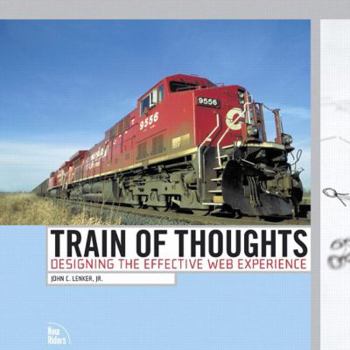
Train of Thoughts: Designing the Effective Web Experience

This title explores the other side of the usability debate - why rejection of design can be just as ineffective as frivolous design. It teaches how to bring the principles of human psychology,... This description may be from another edition of this product.
Format:Paperback
Language:English
ISBN:0735711747
ISBN13:9780735711747
Release Date:January 2002
Publisher:New Riders Publishing
Length:300 Pages
Weight:2.75 lbs.
Dimensions:1.0" x 9.1" x 9.0"
Related Subjects
Computers Computers & Technology Networking Web Design Web Development & Design Web ServicesCustomer Reviews
5 ratings
Lenker captures what it is that appeals to the simple minded
Published by Thriftbooks.com User , 21 years ago
After reading some other books on the topic, I got the impression that some of these authors are so intellectual (or trying so hard to be), that they forget the fact that 99% of the world is simple, uninterested, and in a hurry. In this book, John captures and analyzes what it is that stimulates the average mind. He challenges you to understand the people that realistically you aim to target as a web designer. Today after reading this book, I feel like a more cognizant, perceptive person as it relates to what it is that makes me click - no pun intended.
New Thinking
Published by Thriftbooks.com User , 23 years ago
The best pieces of work in art, music and literature always stir extremely strong emotions in people. An audience's reception to the 'New' is always varied, as understanding and preconceptions (in the case of 'Train of Thoughts', the way in which we view and understand the web experience) are challenged. This is nothing but a good thing.Instead of advocating archaic rules and conventions that are merely reactionary to the mistakes made in the last few years, 'Train of Thoughts' takes steps to review and proactively improve/expand upon the manner in which we communicate and do business on the web in the future. The views here are a world away from Nielsen et al - and as such are extremely valuable for at the very least providing balance to the usability argument, and at the most, changing your perception of what is and isn't a good website and providing you with new ways to approach your work.I have been in the web industry in the UK for 6 years now, and I have a constant battle to change perceptions in people - both within the company I work for, and in clients (potential and existing) of the company I work for. This book is going to be a great help to me in changing those perceptions.Whether you agree with John Lenker's views or not (for the record - I do), this is a fantastic book that every web professional whether design or business focused (or both) should read.
Why is Lenker getting railroaded?
Published by Thriftbooks.com User , 23 years ago
There's no doubt that this will be viewed as one of the most controversial books written on the subject of Web design. Even so, having just read some of the early reviews trashing this book, I had to laugh. The design community has been crying out against the extreme rhetoric of the usability experts, but hasn't had a solid academic rallying point from which to argue until now. Lenker comes along with some solid intellectual arguments FOR creativity and content development and people seem to be crying bloody murder. It would seem that a few nerves have has been touched!Truly, Lenker has written an inspired work that draws from research, experience, and original thinking. Some reviewers are claiming that the book is poorly designed, but so far, not one critic has substantiated their criticism by giving examples of design principles that the book violates! Also, not one person has given any example of a specific point Lenker makes that they think is off-base. The reason? Well, my guess is that they haven't actually read the book -- these early reviews were posted two days after the book shipped. I've had an advanced copy, and I'm just now finishing it!Sure, it's true that there's some room left on every page for imagery--it's called white space and this is a good thing. The reason is that Lenker was smart enough NOT to overwhelm people with page after page filled with solid text containing his thoughtful arguments. I did a quick estimate and it would appear that there are anywhere from 80,000 to 100,000 words in this typographically refined, full color, 1-inch thick, 9" x 9"book. Yes it's a picture book suitable for your coffee table, but it will likely also serve as a college textbook. Imagine that--could making a college textbook interesting to read be a good idea? Must be why there are a number of people with PhDs that have written glowing editorial reviews for this book.Make no mistake. This is not a Web design "show-me-how" book. There are no "step-by-step" examples. Why would there be? This is an online communications philosophy book (says so on the back cover) and presents theories and principles that are solid enough to go toe-to-toe with the one-sided arguments presented in Jakob Nielsen's "Designing Web Usability."At the end of the day, if you're looking for something written at the third-grade level that you can breeze through in an evening of light reading--read something else. There are plenty of slapped-together-books for you to choose from. If on the other hand, you're looking for something to jump-start your work as a Web designer, read Train of Thoughts. This well conceived, well designed, and well argued book will challenge you, inspire you, and will teach you then concepts needed to design truly effective Web experiences (just like the title says).
Attract, Inform, Invoke
Published by Thriftbooks.com User , 23 years ago
Train of Thoughts is an intelligent discussion that strongly supports a subject dear to my heart-the value of engagement on websites. As a curator of online museum exhibits, I am deeply interested in moving beyond the very useful but cold facts of so many online resources and into experiences that have something akin to art and storytelling. Mr. Lenker finally says what I've been longing to hear, and he supports it with multi-disciplinary research and makes it intelligible through well-conceived diagrams. This is not how-to-build-a-website, as another reviewer points out, but how-to-imagine-the-potential-of-websites. It is also not just philosophical ramblings (as the title might seem to imply) but practical advice, complete with case-studies of successful websites and interviews with their creators.In the process, Mr. Lenker revisits the design of a book. Structurally, this is the most successful translation I've seen of the web onto the page. It is not chapters of text but-like a good website-short blocks of text, intelligently headlined, that together complete a larger series of thought. The organization is not standard, but it is easily navigable, enjoyable, and it serves to underscore his points, especially his mantra: attract, inform, invoke.This is a must-read for those of us who create websites. It is not the last word, as the author clearly states, but an eloquent invocation of discussion that I hope will lead to a new vision.
Simply Outstanding
Published by Thriftbooks.com User , 23 years ago
I can't recall the last time I was so utterly (and pleasantly) suprised when I opened a book. Books that espouse usability don't tend to be much to look at, but this book is exquisite. Lenker is going to have to expect the negative reviews from all the Nielsen drones who think that the world should have all the character and appeal of a sign post (sans the sign). Those who are more open-minded (and I would argue, more in tune with the real world) will be treated to a far more balanced perspective on usability. You'll actually get useful information in every chapter--not just the same basic and essentially obvious concepts repeated chapter after chapter like so many "popular" usability books tend to do. I only hope people don't listen to the sign post lovers. This book is simply outstanding.
Copyright © 2025 Thriftbooks.com
Terms of Use | Privacy Policy | Do Not Sell/Share My Personal Information | Cookie Policy | Cookie Preferences | Accessibility Statement
ThriftBooks ® and the ThriftBooks ® logo are registered trademarks of Thrift Books Global, LLC
ThriftBooks ® and the ThriftBooks ® logo are registered trademarks of Thrift Books Global, LLC
