


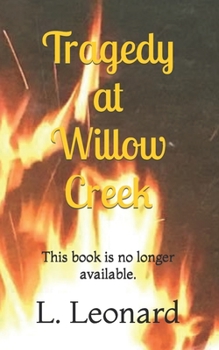
Tragedy at Willow Creek: May not be appropriate for young readers

"Tragedy at Willow Creek" is an extended version of "Buffalo Hunting and Other Ramblings" (a love story.), which Eliza Stoppes referred to as an "UNEXPECTED GEM" and "The sentences had short apt descriptions which made the book feel like a Hemingway story."
As with "Buffalo Hunting," racism, hatred, and bigotry are addressed as evils. This historical fiction expands the author's imagination to include a fictional 1900s community suffering from intolerance through ignorance. A group of "concerned" citizens determined to cleanse the earth of evil by targeting people different from themselves. Although some characters purport to be practicing Christians, they discriminate against others who dress differently or have darker skin. The minorities are accused of violating God's law. The story is inspired by beliefs embodied in an unbroken 1847 peace treaty between warring Comanche and German immigrants. The community around Willow Creek has abandoned the peace-loving philosophy that opened the land to settlers. The violence depicted in this rewrite may not be appropriate for young readers.
INJUN! DON'T BE A FOOL! GIVE US THAT, SISSY, OR WE WILL BURN YOU OUT! IF YOU LOVE THAT WHORE YOU WILL GIVE US THAT F...!" Tactics used by hooded riders forcing their will on others. TA tactic that was then and is now abominable. Follow the lives of Marcus and Quanah (Buffalo Hunting) as they endure an old hatred. The small village near Willow Creek has grown. Newcomers with old ideas have populated this quiet village changing everyone's way of life. The beliefs of their grandparents have evaporated. Only a few stragglers holding on to the old faith are left. A vanishing faith and way of life built this town; it fostered peace and tranquility. The tranquility gave reason for new folks to visit and stay.
Customer Reviews
ThriftBooks ® and the ThriftBooks ® logo are registered trademarks of Thrift Books Global, LLC
