


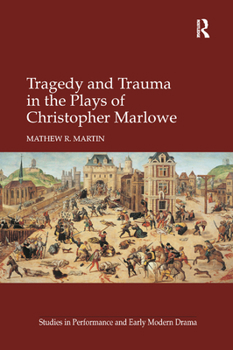
Tragedy and Trauma in the Plays of Christopher Marlowe
No Customer Reviews

Select Format
Select Condition 
Book Overview
Contending that criticism of Marlowe's plays has been limited by humanist conceptions of tragedy, this book engages with trauma theory, especially psychoanalytic trauma theory, to offer a fresh critical perspective within which to make sense of the tension in Marlowe's plays between the tragic and the traumatic. The author argues that tragedies are trauma narratives, narratives of wounding; however, in Marlowe's plays, a traumatic aesthetics disrupts the closure that tragedy seeks to enact. Martin's fresh reading of Massacre at Paris, which is often dismissed by critics as a bad tragedy, presents the play as deliberately breaking the conventions of the tragic genre in order to enact a traumatic aesthetics that pulls its audience into one of the early modern period's most notorious collective traumatic events, the massacre of French Huguenots in Paris in 1572. The chapters on Marlowe's six other plays similarly argue that throughout Marlowe's drama tragedy is held in tension with-and disrupted by-the aesthetics of trauma.
Format:Paperback
Language:English
ISBN:0367880156
ISBN13:9780367880156
Release Date:December 2019
Publisher:Routledge
Length:202 Pages
Weight:0.66 lbs.
Dimensions:0.4" x 6.1" x 9.2"
Customer Reviews
0 rating
Copyright © 2026 Thriftbooks.com Terms of Use
| Privacy Policy | Do Not
Sell/Share My Personal Information | Cookie Policy | Cookie Preferences | Accessibility Statement
ThriftBooks® and the ThriftBooks® logo are registered trademarks of Thrift Books Global, LLC
ThriftBooks® and the ThriftBooks® logo are registered trademarks of Thrift Books Global, LLC
