


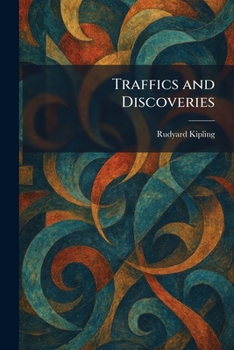
Traffics and Discoveries

Select Format
Select Condition 
Book Overview
"Traffics and Discoveries" is a masterful collection of short stories and poems that showcases the breadth of Rudyard Kipling's creative genius at the turn of the twentieth century. This anthology features some of Kipling's most celebrated and diverse prose, blending tales of military life, naval adventure, and the emerging technological wonders of the era.
The collection includes stories such as "The Captive" and "A Sahibs' War," which delve into the complexities of the Second Boer War, while others like "Wireless" and "Steam Tactics" reflect the author's fascination with the rapid advancements of modern science and transport. Perhaps most notably, the volume contains "They," a haunting and poignant exploration of grief and the supernatural that stands as one of Kipling's most sensitive and enduring works.
Interspersed with lyrical verse that complements the preceding narratives, "Traffics and Discoveries" highlights Kipling's unparalleled ability to capture the vernacular of the common soldier, the sailor, and the engineer. It remains a vital contribution to early twentieth-century literature, offering readers a window into the imperial zeitgeist and the shifting boundaries between the physical and spiritual worlds.
This work has been selected by scholars as being culturally important, and is part of the knowledge base of civilization as we know it. This work was reproduced from the original artifact, and remains as true to the original work as possible. Therefore, you may see the original copyright references, library stamps (as most of these works have been housed in our most important libraries around the world), and other notations in the work.
This work is in the public domain in the United States of America, and possibly other nations. Within the United States, you may freely copy and distribute this work, as no entity (individual or corporate) has a copyright on the body of the work.
As a reproduction of a historical artifact, this work may contain missing or blurred pages, poor pictures, errant marks, etc. Scholars believe, and we concur, that this work is important enough to be preserved, reproduced, and made generally available to the public. We appreciate your support of the preservation process, and thank you for being an important part of keeping this knowledge alive and relevant.
Customer Reviews
ThriftBooks ® and the ThriftBooks ® logo are registered trademarks of Thrift Books Global, LLC
